News
EU-Mercosur: Trade in Three Charts
Intended to liberalize trade between the EU and four Latin American countries, the trade agreement with Mercosur (Argentina, Brazil, Uruguay, and Paraguay) was signed on December 6, 2024. Adopted on September 3, 2025, by the European Commission, it still requires approval by the Twenty-Seven and the European Parliament before entering into force.
On September 3, the European Commission submitted proposals to the Council of the EU for the signature and conclusion of the EU-Mercosur Partnership Agreement (EMPA).
This agreement aims to gradually eliminate tariff barriers and promote greater harmonization of standards, in line with the EU’s vision for agriculture and food. It is important to note that EU sanitary and phytosanitary rules and all European standards will remain fully applicable to imported products.
Tomato Paste
For processed tomato products, the agreement provides that imports of processed tomato products into the EU (currently subject to a customs duty of 14.4%) will be exempt from customs duties seven years after ratification. Conversely, current customs duties applied to European exports to Mercosur will be eliminated ten years after the date of provisional application, as published in the Official Journal.
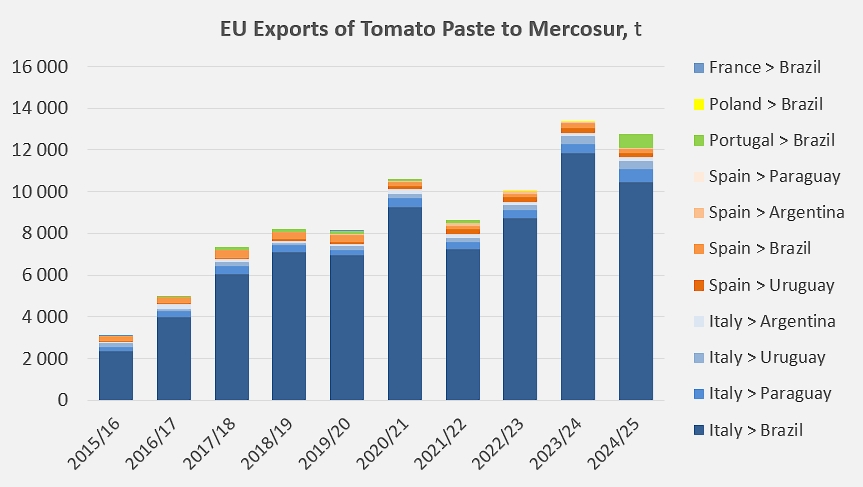
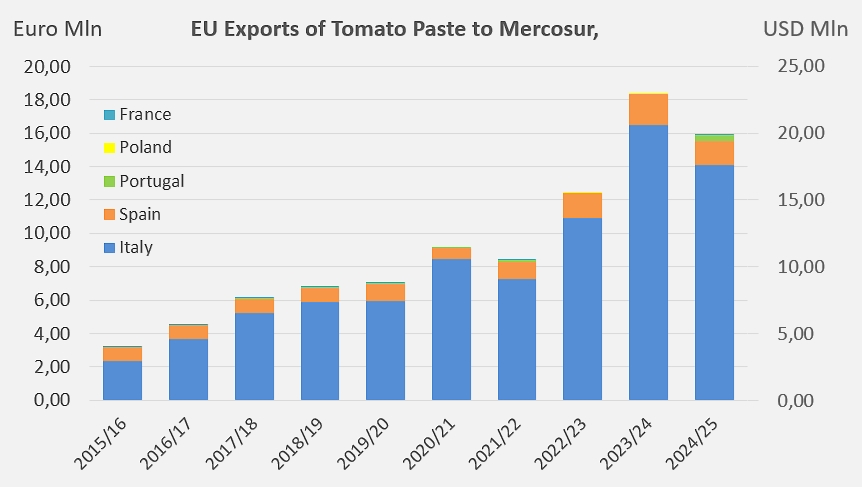
The last ten years have seen exports of tomato paste (customs codes 200290) to Mercosur countries increase significantly, from 3,000 tonnes (t) in 2015/2016 to nearly 13,000 t in 2024/2025. The Italian sector is the main player in this flow, which is mainly destined for the Brazilian market: over the last three marketing years, the volumes mobilized have averaged around 11,000 t.
Spanish, Portuguese, Polish, and French products also contributed to EU exports to Mercosur, but in much smaller quantities, and even with extremely erratic movements: over the period in question, average Spanish exports to Mercosur did not exceed 500 tonnes per year; Portuguese external sales, limited to a few dozen tonnes focused on the Brazilian market between 2015 and 2021, suddenly rose to over 660 tonnes in 2024/2025, after two years of complete interruption.
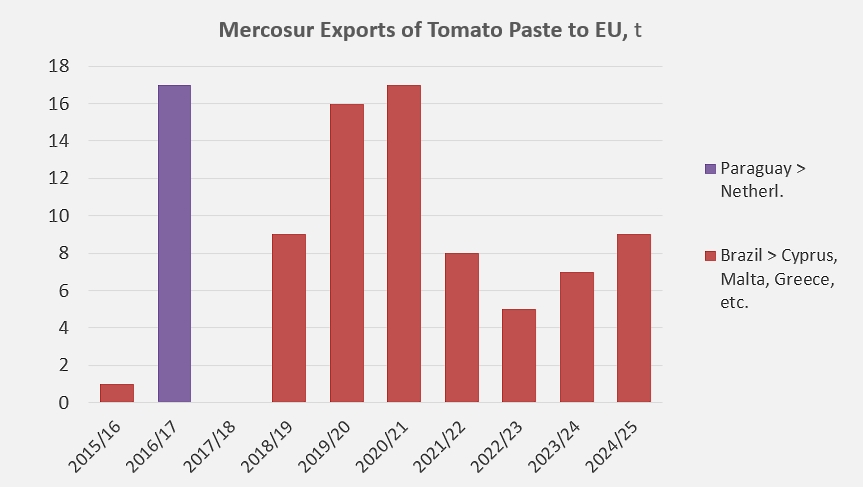
At the same time, movements of tomato paste from Mercosur countries to the European market were practically nonexistent: the largest quantities consisted of a few tonnes, mainly to Cyprus and Malta. The total quantities exported from Mercosur to the EU over the last ten marketing years amounted to 89 tonnes (see additional graphic information at the end of the article).
Canned Tomatoes
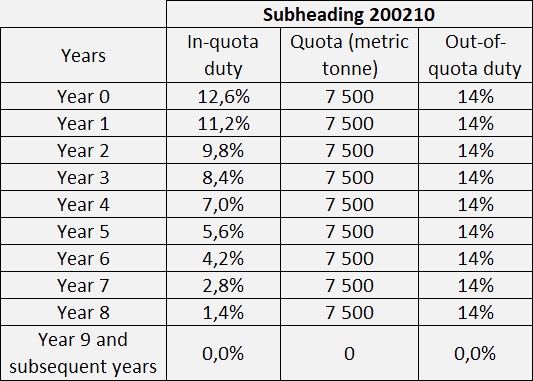
The agreement also provides that customs duties on EU exports of canned tomatoes (customs codes 200210), whether whole or in pieces, prepared or preserved, will be gradually reduced under a quota system, according to the following schedule:
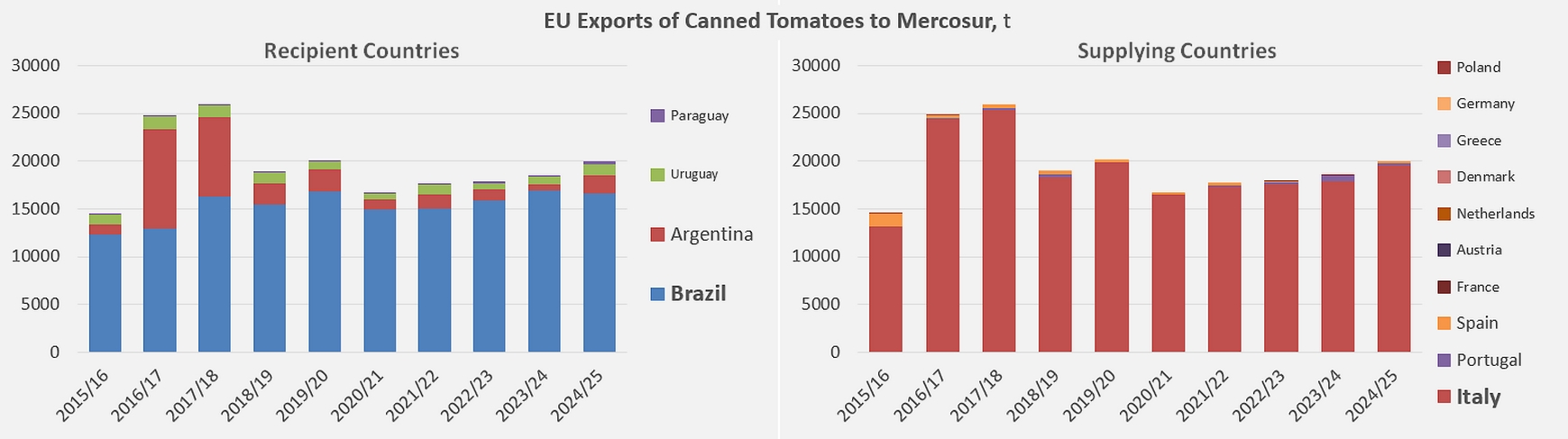
After a significant but temporary increase between 2016 and 2018, annual exports of canned tomatoes from the EU have remained relatively stable over the past seven years, averaging around 18,000 to 19,000 tonnes. As with pastes, these exports mainly concern Italian products destined for the Brazilian market: over the past three financial years, the Italian sector has exported an annual average of 18,300 tonnes, including 16,400 tonnes to Brazil. Conversely, the cumulative exports of canned tomato products from the four Mercosur countries over the last ten marketing years amount to only 72 tonnes.
Tomato Sauces & Ketchup
According to the September 2025 agreement, EU tomato sauce exports (customs codes 210320) to Mercosur (currently subject to customs duties of 16 to 18%) will be exempt from customs duties ten years after ratification.
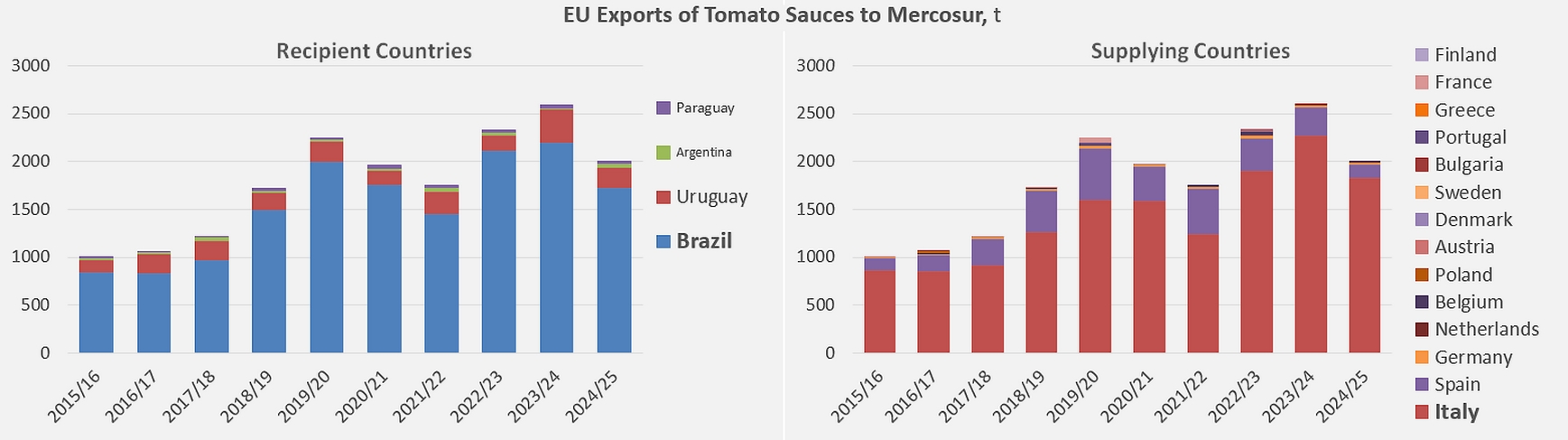
For the time being, the quantities of sauces mobilized in flows from the EU to Mercosur are showing irregular growth, increasing from around 1,000 tonnes in 2015/2016 to 2,600 tonnes in 2023/2024 and then only 2,000 tonnes in 2024/2025. Italy is once again the main player in this trade (an average of 2,000 tonnes over the last three marketing years), whose main customer is Brazil (same tonnage).
Spanish tomato sauces are the only challengers to Italian products, while the Uruguayan market is the only other significant destination for European canned tomatoes.
Over the last ten marketing years, the cumulative exports of sauces and ketchup from the four Mercosur countries to the EU amount to only 83 tonnes.
Over the past three fiscal years, Mercosur accounted for 0.9% of EU tomato paste exports, for 1.1% of EU canned tomato exports, and for 0.2% of EU tomato sauces and ketchup exports.
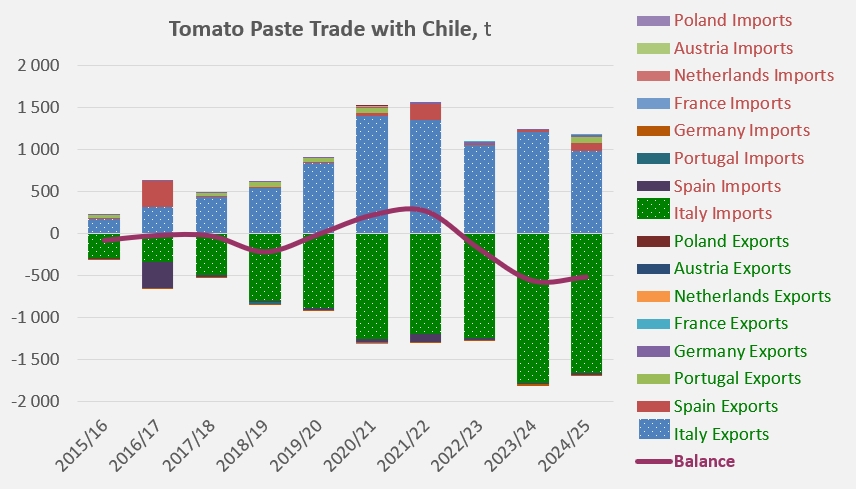
Given the available evidence, it does not appear that ratification of this agreement could have a negative impact on the European tomato processing industry. Among South American processing industries, only the Chilean industry (already duty-free and not part of Mercosur) is a significant exporter of tomato products, particularly tomato pastes, which constitute the bulk of European imports from this region (see additional graphic information at the end of the article).
Trade statistics show that European exports to Mercosur are considerably higher than imports. This suggests that, in the long term, the European tomato processing industry could benefit from trade liberalization with this bloc.
Some complementary data
Tomato paste exports from Mercosur to the EU over the past ten years.
Estimated value of EU tomato paste exports to Mercosur countries in euros and USD.
Evolution and composition of the European trade balance for tomato pastes with Chile.
Source: Trade Data Monitor