News
Since the latest survey carried out among the different WPTC delegations (18 May), the crop situation has evolved, sometimes radically, notably in China. According to a number of professional sources that are independent from the World Council, estimations carried out at the end of May regarding surfaces planted with processing tomatoes in the various regions of China indicate that total surfaces are smaller than planned.
Sources close to Cofco TunHe have stated that the biggest Chinese processor is likely to occupy half of the country's surfaces planted with processing tomatoes this year, covering approximately 280 000 mu (or 18 667 hectares).
This figure corresponds to the information supplied by other sources for China as a whole, which estimate that surfaces planted in Inner Mongolia and Gansu are likely to be 15% less than they were in 2017 (which is respectively about 134 500 mu (8 967 hectares) and 22 000 mu (1 467 hectares). In the South of Xinjiang, the central government's requirements in terms of effluent treatment and the controls imposed on atmospheric pollution have convinced many smaller companies to give up on processing this year. But more importantly, a number of processing plants belonging to Cofco or Chalkis will not even open their doors in 2018. In the final count, according to estimates, planted surfaces (approximately 124 000 mu, or 8 267 hectares) should only cover half of what they did last season.
Finally, in the North of the Xinjiang region, the effects of environmental policies and the contraction of operations carried out by Chalkis are likely to lead to a notable reduction in planted surfaces, estimated at approximately 273 000 mu (18 200 hectares).
Sources close to Cofco TunHe have stated that the biggest Chinese processor is likely to occupy half of the country's surfaces planted with processing tomatoes this year, covering approximately 280 000 mu (or 18 667 hectares).
This figure corresponds to the information supplied by other sources for China as a whole, which estimate that surfaces planted in Inner Mongolia and Gansu are likely to be 15% less than they were in 2017 (which is respectively about 134 500 mu (8 967 hectares) and 22 000 mu (1 467 hectares). In the South of Xinjiang, the central government's requirements in terms of effluent treatment and the controls imposed on atmospheric pollution have convinced many smaller companies to give up on processing this year. But more importantly, a number of processing plants belonging to Cofco or Chalkis will not even open their doors in 2018. In the final count, according to estimates, planted surfaces (approximately 124 000 mu, or 8 267 hectares) should only cover half of what they did last season.
Finally, in the North of the Xinjiang region, the effects of environmental policies and the contraction of operations carried out by Chalkis are likely to lead to a notable reduction in planted surfaces, estimated at approximately 273 000 mu (18 200 hectares).
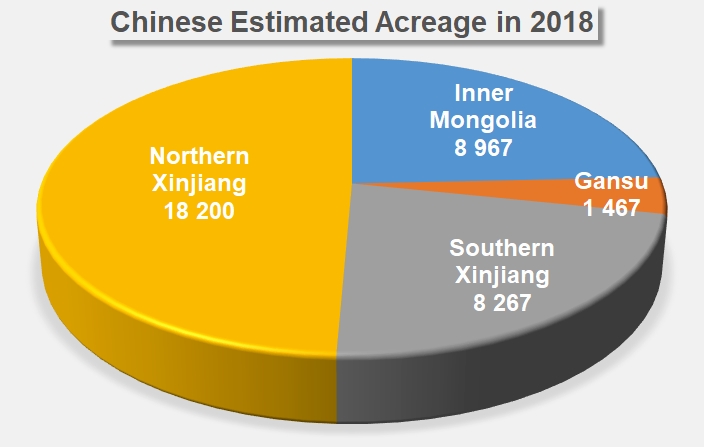 In total, crops of tomatoes for processing should cover slightly more than 553 000 mu this year, which is approximately 36 900 hectares. Given the average productivity figures over the past five years (84 mT/ha or 5.6 mT/mu), it seems reasonable to expect China's production to reach 3.1 million mT in 2018. If yields were to reach as much as 6 mT/mu (90 mT/ha), quantities for processing would amount to 3.3 million mT. The target volume of 3.8 million mT would require a yield of close on 7 mT/mu (more than 104 mT/ha).