News
California: New PTAB Color Score in 2018
Starting in 2018, the Processing Tomato Advisory Board (PTAB) transitions to a new color scale in processing tomato grading stations.
The change was made to modernize PTAB current systems. The previous LED color systems were first deployed in 1996 and after 21 years of service maintenance costs were an increasing concern. The old PTAB scale gave a 20 for fully mature, red fruit and 40 for orange, or rather immature fruit. While the scale has been used across PTAB stations for many years, we are introducing a new method of color assessment.
The benefits of the new system include the following:• Lower service expenses
• Provides L a b scores that correlate to finished product – helps industry better predict varietal performance and processing practices.
• Improves operational efficiencies at inspection stations resulting in lower labor costs to growers and processors.
• Ultimately will speed up the inspection operations which will lower across the board costs to all related parties – growers, processors, truckers, PTAB and grading station operators.
 The new method uses a Minolta CR-410 color measurement instrument which produces a new color score called the Hunter Hue Angle. Using Minoltas makes it easier for the industry to match inspection results as Minoltas are available over the counter. The LEDs were designed and built in-house thus making it extremely difficult to match the results.
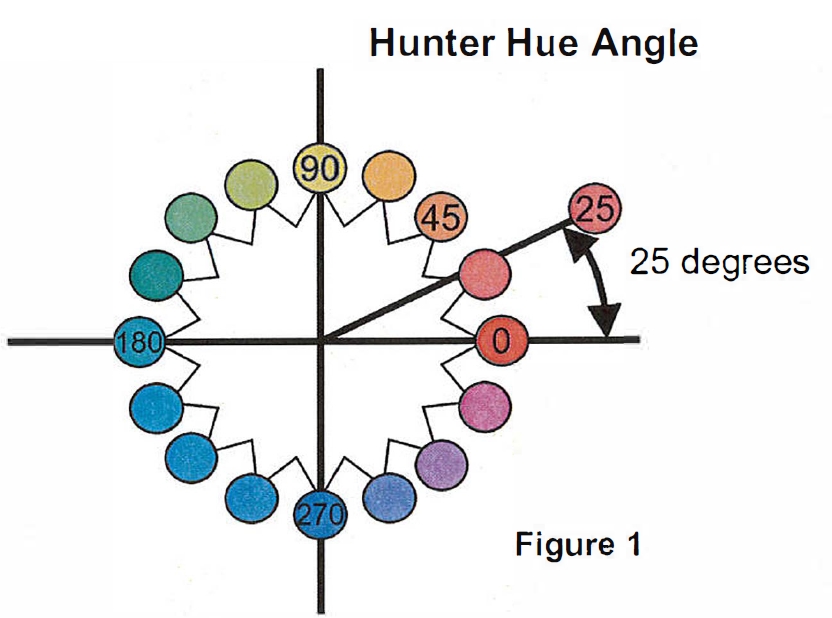
The Hue Angle method distinguishes between colors using the angle along a color wheel with values going from 0 to 360 degrees, as shown in Figure 1.
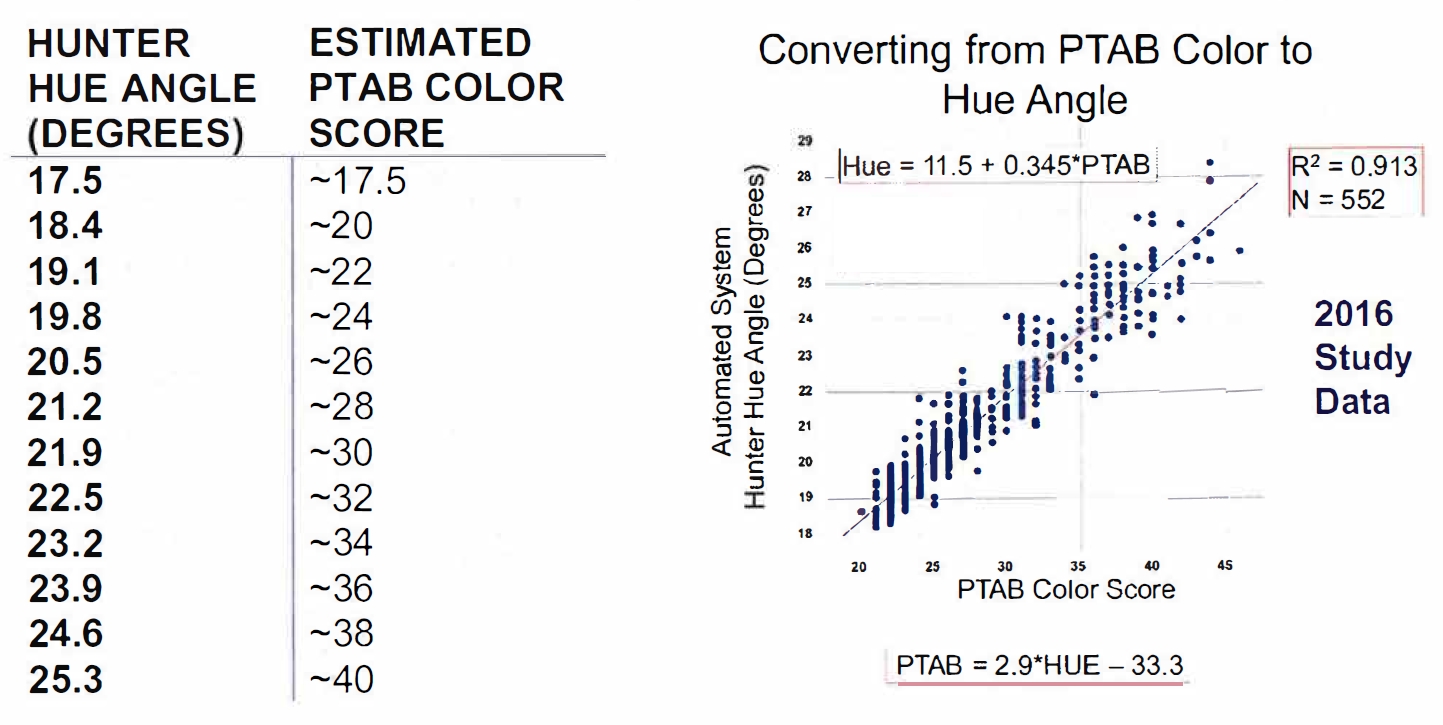
The Hue Angle of processing tomatoes typically ranges from 17 to 25. While not a perfect conversion, it is possible to estimate an average PTAB color score from the Hue Angle score using mathematical formulas.
Measuring Tomato Color with Minolta
Color is an important indicator of maturity in tomatoes and is an important tool for managing product quality in the processing tomato industry. The Hue Angle allows for an objective grading of color. It is a part of a larger measurement method, the Hunter Lab Color Space.
The Hunter Lab color score uses a combination of hue, lightness, and saturation to describe a color. Hue is what forms the base of the colors we can name, represented by the color wheel in Figure 1. Lightness is an added modifier that determines how bright or dark the color is. Saturation is an additional modifier that indicates how vivid or dull the color is.
While all three characteristics are used in the Hunter Lab color score, the maturity of tomatoes is characterized by the hue angle moving from green to yellow to red. This is why it is used as the official grade of maturity in the new color assessment system.
As an alternative form of expression to hue, saturation, and lightness, color can also be expressed according to a rectilinear coordinate system. The x-axis is represented by a, the y-axis is represented by b, and the z-axis is represented by L, as shown in Figure 2.
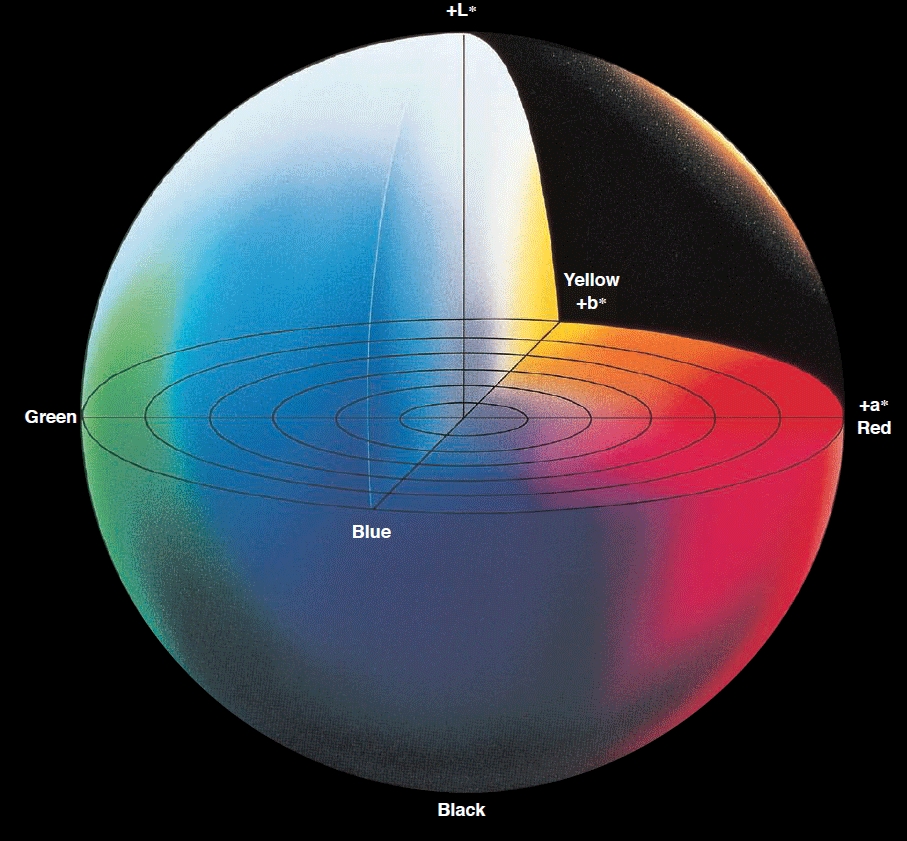
“L” is the lightness of the color in the vertical direction; “a” and “b” values indicate color directions towards red, blue, yellow, and green. The Lab color space is widely used in modern food production systems. By adopting this notation, we are able to standardize scores across quality control laboratories in tomato processing facilities.
Source: PTAB, Konica Minolta
For further details about Hue Angle or the Lab Color Space, visit: