News
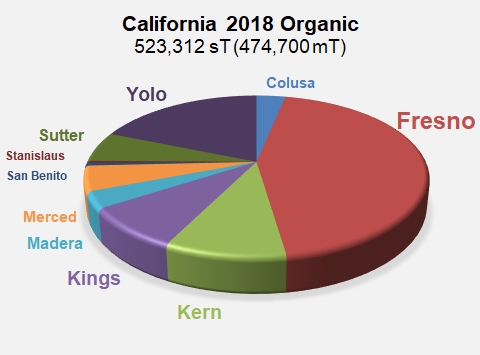 In 2018, the Californian industry processed close on 475 000 metric tonnes of organically grown tomatoes.
Three counties accounted for almost three quarters of the production delivered to Californian processing plants: crops grown in Fresno county alone accounted for 44% of California's total organic production, while the counties of Yolo and Kern added respectively 19% and 10% to that volume.
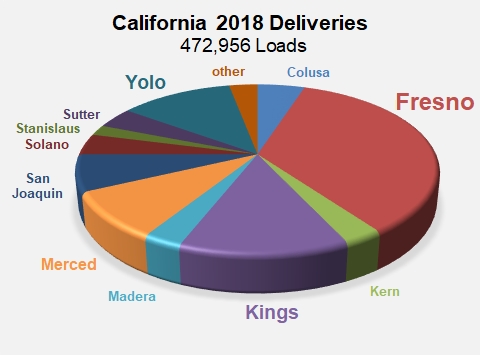 Being the main supplier of organic tomatoes, Fresno is also California's leading county for the supply of processing tomatoes overall, with 35% of the total crop last year. In 2018, Yolo ranked second for organic tomatoes and third for processing tomatoes in general, with 12% of the shipments, right behind Kings county (13% of the total, but only 8% of the organic crop). The county of Kern is very active in the organic sector (10% of the volumes last year), but only accounts for a small proportion of California's total tomato crop. Conversely, the county of Merced, which grew 9% of overall volumes harvested in 2018, is only marginally involved in the organic sector.
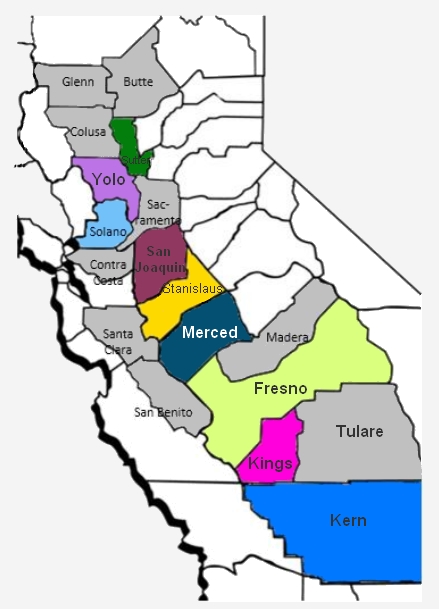 Last year, taking account of all quality criteria and industrial destinations, the four main Californian counties that grow processing tomatoes supplied factories with just under 7.7 million metric tonnes, which is equivalent to 80% of the EU's total processing tomato volume. Fresno county's crop alone (3.871 million mT) exceeded the volumes grown in China (3.8 million mT), while the production of Kings and Yolo (1.4 million mT and 1.37 million mT) could be compared to the size of the crops grown in Turkey or Brazil. In 2018, Merced county, which ranks fourth in this list, produced a volume (1.04 million mT) that is comparable to the production of Chile in 2017 (1.08 million mT). Finally, the volumes harvested in the county of San Joaquin in 2018 (817 000 mT) were recorded at a volume that is similar to what Ukraine plans to process in 2019.
Source: USDA, WestConFoods