News
Bolivia: the market is highly dependent on neighboring countries
Bolivian consumers pay attention to price but do not neglect quality, especially when it comes to private label products. The country has a small-scale industry, but must import tomato products from neighboring countries to meet national demand.
Bolivia's economy is mostly based on the extraction and export of its natural resources, mainly mining and gas, two economic activities that feature among its primary sector operations. Within the secondary sector, the industries that stand out in terms of sales are beer, dairy, oilseed, automotive, cement and textile .
In recent years, GDP growth has averaged 4.7%, generating budget surpluses for the first time since 1940. The proportion of the population that is economically active is 71.9% and the unemployment rate is 6.5%, one of the lowest in the region. The average monthly salary is USD 465.
In 2022, India was the main destination for Bolivian exports, with an FOB value of USD 2.2 billion, mainly from the sale of minerals. Brazil and Argentina come next in importance, with a focus on purchases of natural gas. In terms of imports, China is Bolivia's biggest supplier, accounting for 21% of imports across all sectors. Argentina is Bolivia's third-largest trading partner, second in the region after Brazil, accounting for 17% of Bolivian imports. Bilateral trade between Argentina and Bolivia averages USD 2.3 billion a year.
 Bolivian consumers buy crushed tomatoes or tomato sauce in supermarkets or local markets. The consumption and uses of the product vary according to the age of the consumer: young people eat more canned tomatoes than older people, or have more time to devote to cooking. Consumers are generally price-conscious, but won't renew their purchase if the quality isn't consistent in terms of color, acidity and texture. On the other hand, those with lower purchasing power consume private label brands (specific to supermarkets), while those with greater purchasing power do not consider them attractive.
Because Bolivia produces less than it consumes, it imports crushed tomatoes in small quantities, mainly from Argentina and Italy. The ACE 36 Economic Complementarity Agreement between MERCOSUR and Bolivia has been in force since 1997 and, since 2011, all products included in the tariff agreement are 100% exempt on presentation of the certificate of origin. In fact, the largest agro-industrial companies in San Juan (Argentina) are exporting to this market with increasing regularity.
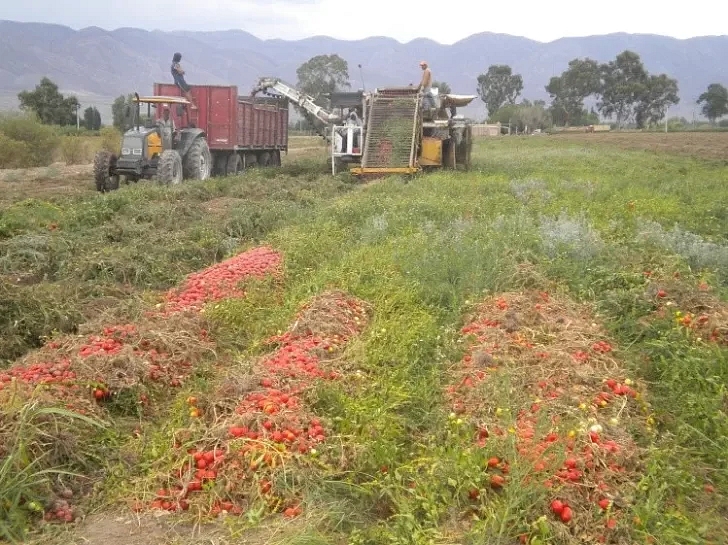 It is important to note, however, that Bolivia has its own small-scale production of crushed tomatoes, with a cultivated area of around 5,000 hectares and a production of 49,000 tonnes.
According to the Bolivian press, Argentinean exports of products totaled around 2,208 tonnes in 2023, for over USD 1.588 million in FOB values. Among the main products exported are raisins, various packaging closures, plasterboard, prepared or preserved olives, ketchup and other tomato sauces in packs of less than 1 kg. Of the total value of the agro-industrial sector, which amounted to USD 153,731 FOB, ketchup and other tomato sauces in containers of less than 1 kg accounted for almost 64% of the total, or around USD 97,715. Next come tomatoes prepared or preserved without vinegar or acetic acid, excluding whole tomatoes, chunks or juice, which accounted for 28% of the total with around USD 42,608, and in third place whole tomatoes or chunks, prepared or preserved, which accounted for 5% (around USD 6,987).
Some complementary data
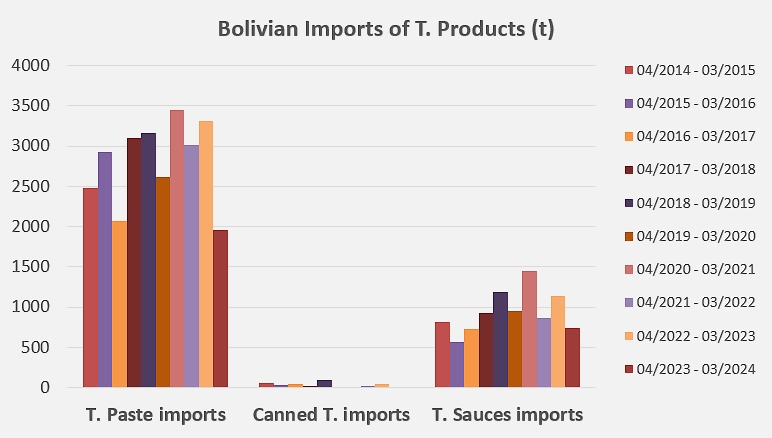
Bolivian imports (April-March) of tomato products since 2014. According to data provided by Trade Data Monitor, Bolivia buys most of its tomato paste from Peruvian and Brazilian suppliers. Canned tomatoes come from Argentina, while sauces and ketchup are mainly supplied by Chilean, Peruvian, Argentinean, Brazilian and US suppliers.
Sources: diariodecuyo.com.ar, TDM