News
Argentina: concerns over market opening
The recent opening of the Argentine market to imports of tomato paste is causing serious concern within the national processing industry, particularly in the Cuyo region, which had enabled the country to achieve near-self-sufficiency in recent years. Guillermo San Martín, director of the Tomate 2000 Association, and Raúl Giordano, head of the Mendoza Chamber of Fruit Industries (Cámara de la Fruta Industrializada de Mendoza, CAFIM), are sounding the alarm about the potential consequences of this measure on production, employment, and the regional economy.
The Tomate 2000 Association emphasizes that efforts to make the Cuyo region the country's leading producer of industrial tomatoes brought Argentina closer to self-sufficiency last year and thus led to a significant reduction in imports. This dynamic, however, risks being challenged by the liberalization of imports, particularly of concentrated tomato purees from Chile and China. The Argentine market, characterized by high individual consumption of processed tomato products, is particularly attractive, but this trade opening, according to San Martín, exposes the sector to unequal competition and jeopardizes the progress made.
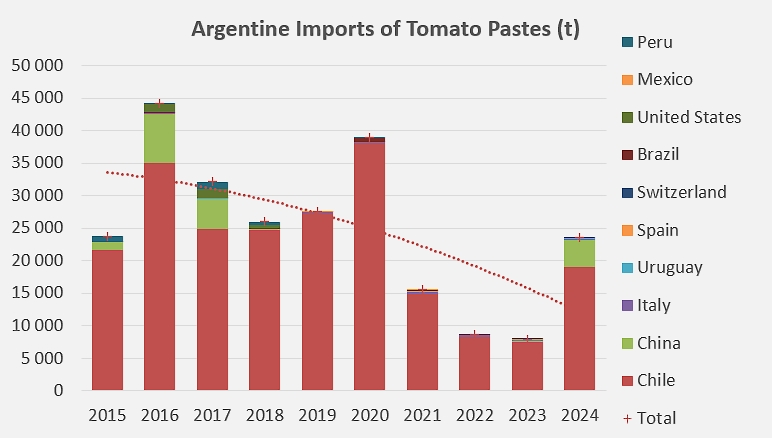
Sector stakeholders highlight the technological advances that have made it possible to achieve record yields, sometimes even higher than those of the world's leading producers. This competitiveness, the result of the Association's work in technology transfer, is directly threatened by the arrival of imported products at relatively low prices. According to figures provided by the Argentine customs service, nearly 9,300 tonnes (t) of concentrates were imported in January 2025, which should be compared with the total of 23,500 t for the whole of 2024; Local stakeholders highlight "the scale and speed of the influx of foreign products, particularly Chinese ones, at prices that defy all local competition."

The Tomate 2000 Association fears that the new situation will lead to a significant reduction in cultivated areas and significant job losses. The Association estimates that 2,000 to 3,000 hectares could be affected, and that independent producers, more vulnerable to market fluctuations, would be the first to be impacted. The effects of a decline in activity are also likely to spread throughout the sector, particularly nurseries, input suppliers, and farm workers. Industrial tomato processing is a sector that requires significant labor and capital, which amplifies the potential socio-economic impact of this crisis.
Faced with this alarming situation, the Tomato 2000 Association has approached the Ministries of Production in Mendoza and San Juan, obtaining "financial aid that is currently considered insufficient to address the emergency. A two- or three-year transition plan would have been needed to prepare for the reopening. Now we are facing competition with no room for maneuver," lamented San Martín.
Raúl Giordano of CAFIM shares these concerns, emphasizing that opening the Argentine market to imports endangers the entire production chain. He highlights the joint efforts of producers, INTA, and nursery operators to increase productivity and reduce dependence on imports, a goal that has been practically achieved in the key regions of Mendoza, San Juan, and La Rioja. Import liberalization is jeopardizing this progress and discouraging future investment, even though advanced technologies have been incorporated to improve efficiency.
CAFIM is calling for protective measures for the domestic industry, such as setting import quotas or reducing electricity taxes for the sector. Approaches have been made to national and provincial authorities to discuss this issue. CAFIM believes the situation remains critical in terms of agricultural input costs and packaging production and emphasizes the urgency of making decisions before the start of production programs for the next season in May. Without clarity, many producers could reduce their harvests or even abandon tomato production altogether.
Some complementary data:
Evolution of Argentine spending on tomato paste imports over the past ten years.

Sources: diariosanrafael.com.ar, Trade Data Monitor