News
Analysis of mold in tomato products
 On May 27th Dr. Elisabeth Varga from University Vienna will talk about “Alternaria toxins in tomato juices” during the International Fruit and Vegetable Juice Association (IFU) online technical webinar.
 Tomato products pose a risk of infection with different molds. Checking processed tomato products in respect of quality aspects is mandatory. Worryingly, German consumer magazine Öko-Test entitled in their lattest issue “Strained tomatoes: moldy tomatoes in every fifth passata” [1]. Plant protection with respective fungicides, rigorous sorting and laboratory analysis can be pillars to tackle this problem. All measures need to be paid for by the consumer which is a challenge in today’s food business environment. This article will shed light on analytical possibilities to assure quality and safety of tomato products.
Alternaria toxins
The main pathogen in tomato fruits is Alternaria sp. which attack damaged tomatoes immediately. Species of Alternaria can produce around 70 toxic secondary metabolites. Due to potential importance for food safety the European Food Safety Authority (EFSA) has carried out an assessments on a few of the known Alternaria toxins and issued a Scientific Opinion [2] in which so called thresholds of toxicological concern (TTC) are given. In 2016 an evaluation of the dietary exposure of the population to Alternaria toxins was published [3] and in consequence Alternariol (AOH), Alternariol monomethyl ether (AME), Tenuazonic acid (TeA) and Tentoxin (TEN) are considered “emerging mycotoxins” as toxicological effects observed include cytotoxic, teratogenic, mutagenic and carcinogenic effects.
EU-wide limit values for Alternaria toxins do not exist until now. Currently there is only a draft of a Commission Recommendation on the monitoring of the presence of Alternaria toxins in food. For processed tomato products the following so called indicative levels are given: AOH: 10 µg/kg, AME: 5 µg/kg and TeA: 500 µg/kg. It is expected to be published shortly.
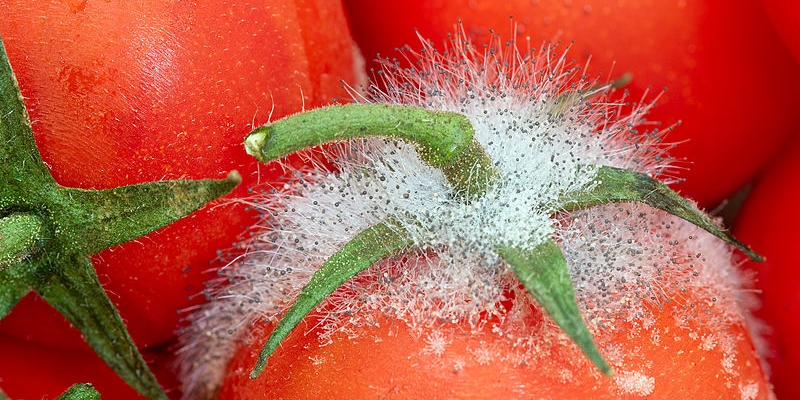
 Alternaria alternata by Abdulghafour, CC BY-SA 4.0
During harvest respectively raw material delivery temperatures can easily reach 40°C in the growing areas. At the factories long queues of trucks can sometimes be seen during season waiting to unload. During this time spoilage by microbiological growth occurs. Especially mold and lactic acid bacteria start to multiply. Therefore quick processing of sound tomatoes is important. The slower the process, the higher the contamination with molds and other bacteria and consequently their metabolic products such as lactic acid or Alternaria toxins can be found in the product.
Howard mold count
The Howard mold count is a standardized microscopical technique for measuring mold contamination on raw material in homogeneous tomato products, in particular tomato paste. The mold contamination is determined microscopically with a special measuring cell. The measuring cell into which the tomato paste is filled has a grid-shaped measuring field divided into 50 equal fields. Each grid field containing microscopically recognizable mold is evaluated. The Howard mold count is given as the percentage of positive fields in relation to their total number. According to decades of practice, which is derived from Regulation (EC) No 1764/86 (on minimum quality requirements for tomato-based products eligible for production aid), the Howard mold count may not exceed 70% for tomato concentrate and sieved tomatoes. Experience has shown that the Howard mold count for good quality products is well below 40%. The method must be considered somewhat error-prone if conducted by unexperienced staff.
Ergosterol content
Another method of choice for packed tomato products but also other commodities is the analysis of Ergosterol. The presence of Ergosterol in a product is an indicator of contamination with molds as it is present in cell membranes and the mold itself is not detectable in microbiological analysis after pasteurization. IFU method No. 81 is the recommended analysis procedure as it is validated of found fit for purpose. It should be noted that there is no strict correlation to the Howard Mold Count.
The maximum value of 17.5 mg/kg dry matter used in Germany is based on a recommendation of the Federal Association of the German Delicatessen Industry and is not a lawful requirement but a generally accepted standard. Also the AIJN Code of Practice has set an industry standard by a provisional maximum value of 0.76 mg/l for tomato juices.
The presented analysis shall give an impression of what can be done to assure quality. The necessary expertise for tomato products can be found at GfL Gesellschaft für Lebensmittel-Forschung mbH in Berlin.
Source: Mikko Hofsommer and Karsten Kowalski, GfL Gesellschaft für Lebensmittel-Forschung mbH, Berlin
[1] Ökotest Magazin 5/2021, p.27 ff
[2] EFSA Journal 2011;9(10):2407
[3] EFSA Journal 2016;14(12):4654