News
AGROSUS unveils a weed database
The European AGROSUS project announces the launch of a groundbreaking weed database, featuring detailed information on 117 weed species, including their herbicide resistance, herbicide treatments, and agroecological management strategies. This innovative tool is designed to support farmers, researchers, and policymakers in advancing sustainable agriculture and integrated weed management practices.
The AGROSUS database includes common names for each weed species across multiple regions and is available in 13 languages to facilitate knowledge-sharing and improve weed management strategies across diverse agricultural landscapes.
Tomato is one of the crops listed in the database.
To enhance its impact, the AGROSUS weed database is linked to key international initiatives, including Pl@ntNet, a collaborative plant identification platform, and WeedScience, a global resource on herbicide resistance. Additionally, AGROSUS aligns with its sister project, GOOD, further strengthening the network of sustainable agricultural research and innovation.
This initiative reflects AGROSUS’ commitment to promoting environmentally friendly weed control strategies and reducing reliance on chemical herbicides. By integrating scientific data with agroecological approaches, the platform provides a valuable resource for tackling weed management challenges in a changing climate.
The database can be accessed at:
Discover our Weeds Database | AGROSUS.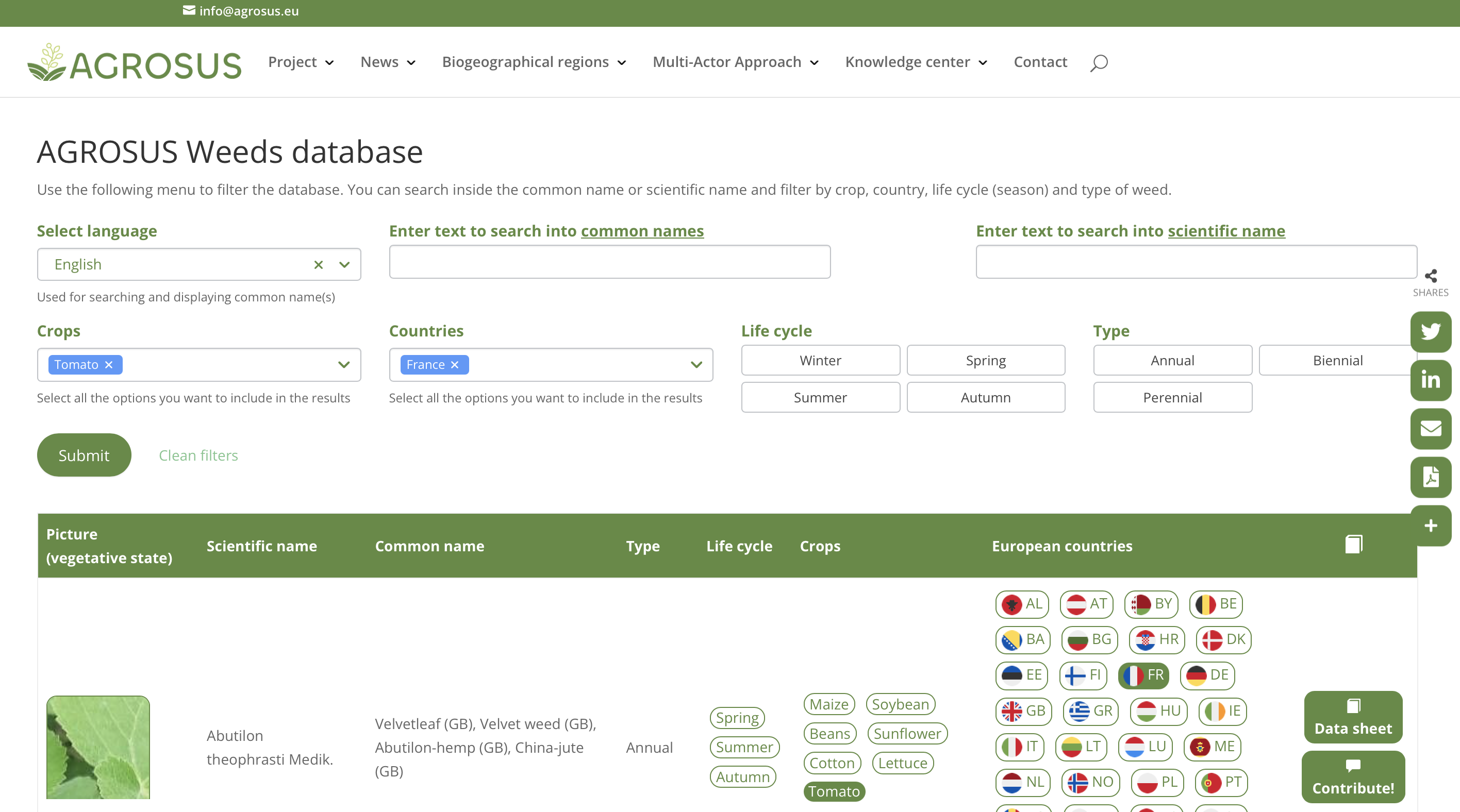
About AGROSUS:
 AGROSUS (AGRoecological strategies for SUStainable weed management in key European crops) is a four-year transdisciplinary research project. The project aims to identify appropriate tools and agroecological strategies to prevent and manage weeds in relevant crops, in conventional, organic and mixed farming. This research will be developed across 11 biogeographical regions (Alpine, Anatolian, Arctic, Atlantic, Black Sea, Boreal, Continental, Macaronesian, Mediterranean, Pannonian and Steppic) of the EU and associated countries with the aim to reduce reliance on synthetic herbicides and the correlated pressure on the environment. These biogeographic regions will be covered for co-creation and co-validation activities targeting the best agroecological strategies to be implemented in AGROSUS. Its Key Performance Indicator will be the creation of 14 regional stakeholder communities and 24 crop-linked groups including at least 500 stakeholders.
 AGROSUS (AGRoecological strategies for SUStainable weed management in key European crops) is a four-year transdisciplinary research project. The project aims to identify appropriate tools and agroecological strategies to prevent and manage weeds in relevant crops, in conventional, organic and mixed farming. This research will be developed across 11 biogeographical regions (Alpine, Anatolian, Arctic, Atlantic, Black Sea, Boreal, Continental, Macaronesian, Mediterranean, Pannonian and Steppic) of the EU and associated countries with the aim to reduce reliance on synthetic herbicides and the correlated pressure on the environment. These biogeographic regions will be covered for co-creation and co-validation activities targeting the best agroecological strategies to be implemented in AGROSUS. Its Key Performance Indicator will be the creation of 14 regional stakeholder communities and 24 crop-linked groups including at least 500 stakeholders.
The AGROSUS project is coordinated by the Universidad de Vigo (UVIGO) from Spain and involves 16 partners from 11 European and associated countries along with several universities, a research centre, a company, non-governmental organizations, a farm, a farm association, and an advisor organization.
For more information:
- Project website: www.agrosus.eu & video
- Project coordinator: Adela María Sánchez Moreiras adela@uvigo.gal
- Communication Leader: Tamara Rodríguez Silva trodriguez@feuga.es