News
Innovation: a tomato-based rubber (INRAE)
Tomato rubber, linen car parts… French research is looking for tomorrow's sustainable materials
Organic waste, if recovered, could become new sources of energy. INRAE researchers are interested in many of them, such as tomato skins, which are thin, hydrophobic but also very stretchable.
Organic waste, if recovered, could become new sources of energy. INRAE researchers are interested in many of them, such as tomato skins, which are thin, hydrophobic but also very stretchable.
Finding alternatives to fossil fuels, making use of the by-products of industrial activity… The challenge seems more urgent than ever in view of the current energy crisis. At the INRAE, a French public research organization and world leader in agriculture, food and environmental issues, the stakes are so high that they have made it a "strategic priority". For several years now, hundreds of researchers have been trying to unlock the secrets of biomass, all those organic wastes that can become sources of energy, in order to imagine new ways of using them.
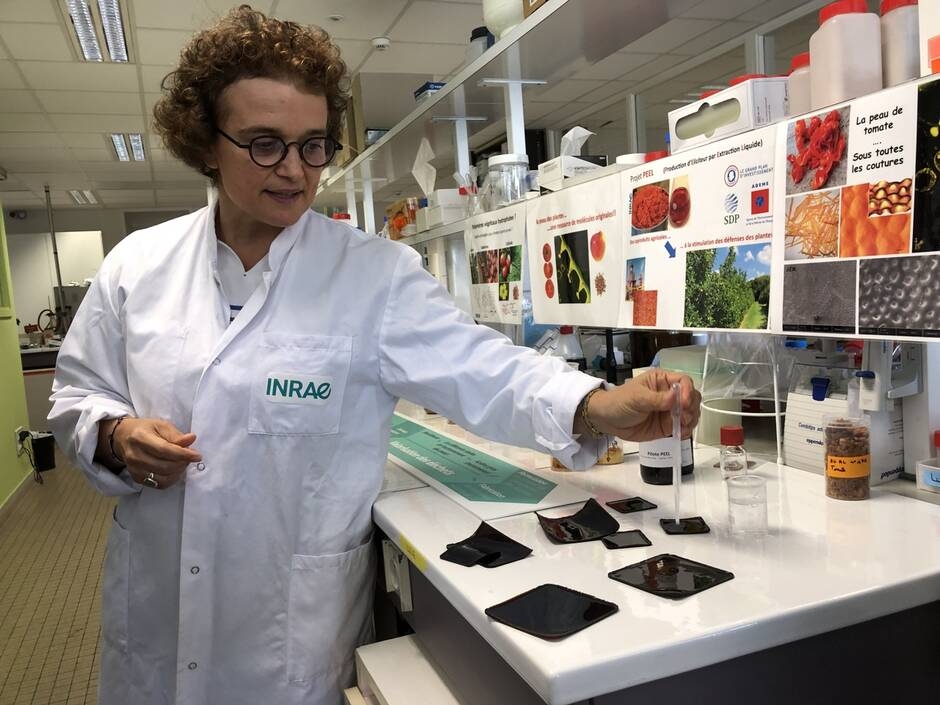 Bénédicte Bakan is an INRAE researcher based in Nantes
In her Nantes laboratory, Bénédicte Bakan works on black rubber parts, which, though it is difficult to imagine, are made from tomato skins: "We found that the skins are thin, hydrophobic but also very stretchable," she explains. "We are able to deconstruct polymers in order to isolate monomers and also reassemble these molecules to build a modified polymer." Or to put it another way, it is a 100% natural rubber, biodegradable and very promising, even if "tomato sauce factories will never be active enough to make tires," the scientist says with a smile. But the process could be applied to other fruits and vegetables, such as apples, of which there is a lot of waste from cider factories and canneries. This is one of the challenges of the bioeconomy: the reuse of all agricultural and agro-industrial residues to replace products of "petroleum" origin, provided that they offer comparable services but also at a similar cost.
Tomato skin cutin for new polymers
Already, in July 2020, INRAE researchers explained that "1.5 million tonnes of tomato waste are produced each year by the tomato processing sector. These waste materials represent a potential source of original molecules."
A team from the INRAE Biopolymers Interactions Assemblage (BIA) unit in Nantes has been working on developing solutions to create new materials such as biodegradable and recyclable elastomers (rubber), or biocontrol solutions to help plants defend themselves better.
The plant organs are covered with cuticle (skin) whose skeleton, the cutin, is a polyester composed of lipid monomers (hydroxylated fatty acids) and glycerol. This hydrophobic polymer controls the development of the plant and provides a protective barrier for the plant against its environment (resistance to drought, pathogens etc.). Furthermore, this cuticle impacts the quality of the fruit during their development (appearance of cracks), their conservation after harvest and their technological processing.
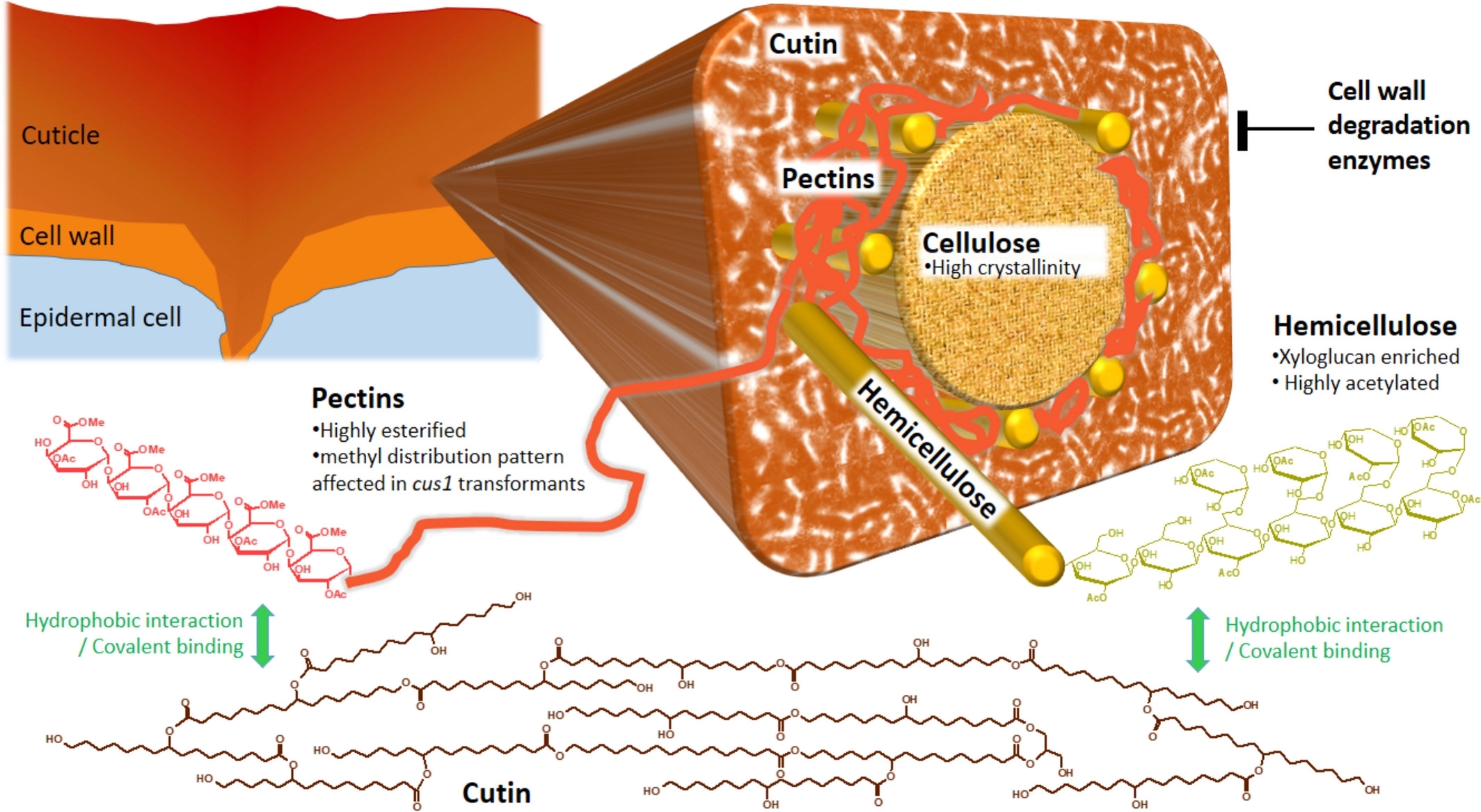
The cuticle covers the surface of all plants and performs crucial biological functions (resistance to dehydration, adaptation to climatic and biological stresses). These properties are determined by the particular structuring of the cuticle, a natural composite comprising lipids (cutins) and cell-walls (polysaccharides). However, this mechanism has not yet been elucidated. In particular, the cell-walls embedded in the lipid polymer of cutin have been poorly accessible to investigation and their nature remained unknown.
Using tomato fruit as a model, the combination of appropriate pretreatment methods (chemical and enzymatic) coupled with several complementary investigation methods (spectral, biochemical, immunocytochemistry, mapping) has led scientists to determine for the first time the fine structure of the cell-walls embedded in the cutin polymer (PEC). The characteristics of these PECs (composition, hydrophobicity, crystallinity) are very different from those of non-cutinized plant cell-walls, which implies a particular role in the functions of the cuticle. Furthermore, the research team showed that a modification of the degree of polymerization of the cutin generates specific modifications of the PEC, which shows a lipid/wall dialogue in the assembly of the cuticle.
These results open new avenues for the knowledge of cuticle construction in plants, and for the production of new bio-inspired materials.
Some complementary data
This study was conducted by the BIA unit (Nantes) in collaboration with the Fruit Biology Pathology unit (Bordeaux) and the SMIS line of the SOLEIL synchrotron, and carried out within the framework of Glenn Philippe's thesis for the INRAE of the "Pays de la Loire" region.
It was the subject of an joint publication: Philippe, G., N. Geneix, J. Petit, F. Guillon, C. Sandt, C. Rothan, M. Lahaye, D. Marion and B. Bakan (2019). "Assembly of tomato fruit cuticles: a cross-talk between the cutin polyester and cell wall polysaccharides." New Phytol.
The publication can be consulted at:
https://nph.onlinelibrary.wiley.com/doi/10.1111/nph.16402
Sources: inrae.fr, 20minutes.fr