News
Canada’s Processed Tomato Industry: Trade Flows and Import Dependencies
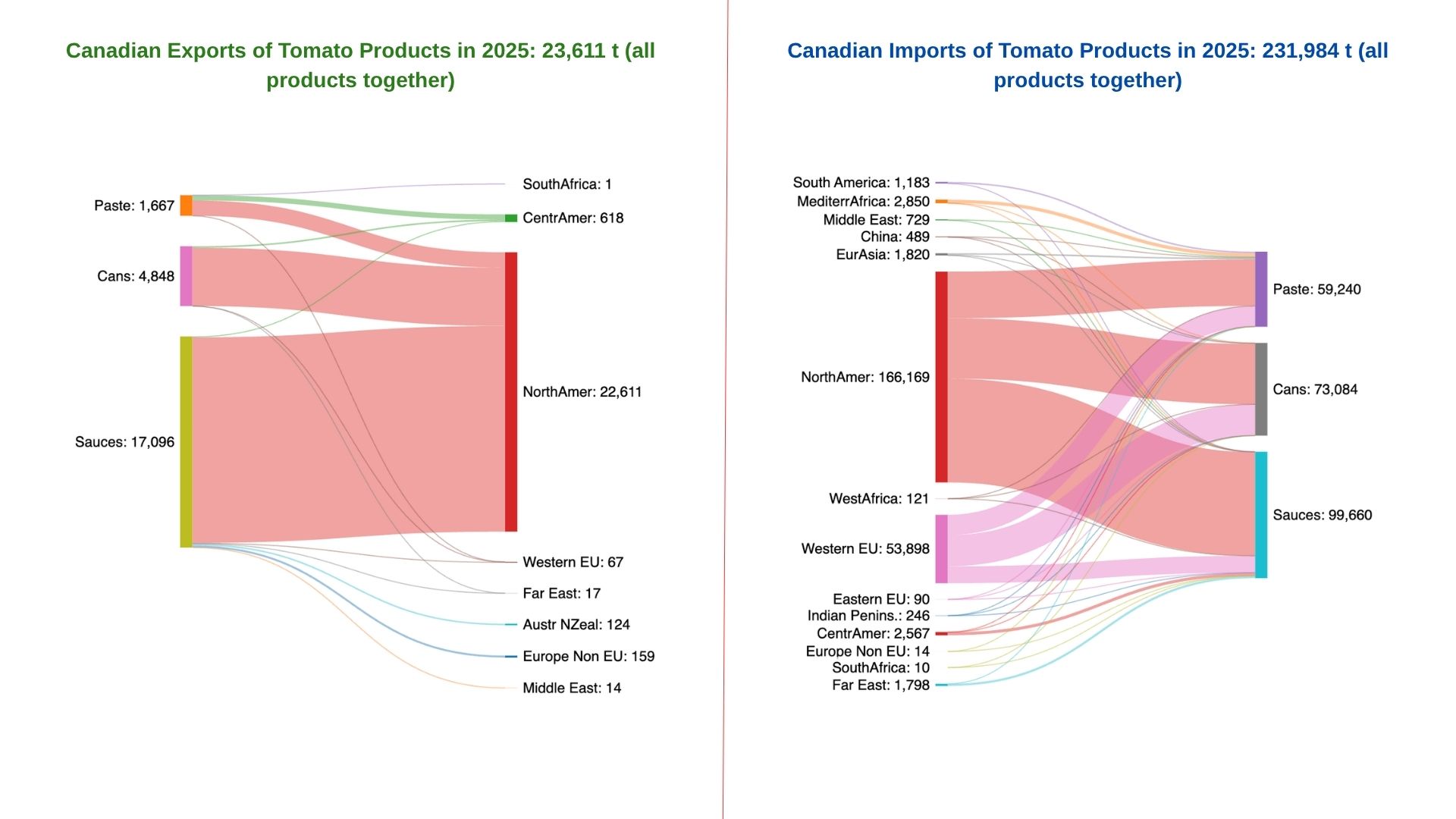
Between 2021 and 2025, the Canadian market for processed tomato products confirmed its massive structural dependence on foreign supplies. Canada processes, on average (calculated over the last five years), slightly more than 500,000 metric tonnes annually. While it exports some derivative products (mainly sauces), it remains heavily reliant on imports across all three main categories. This analysis details the national trade deficit, the geography of import-export flows, and the specific dynamics of each product category.
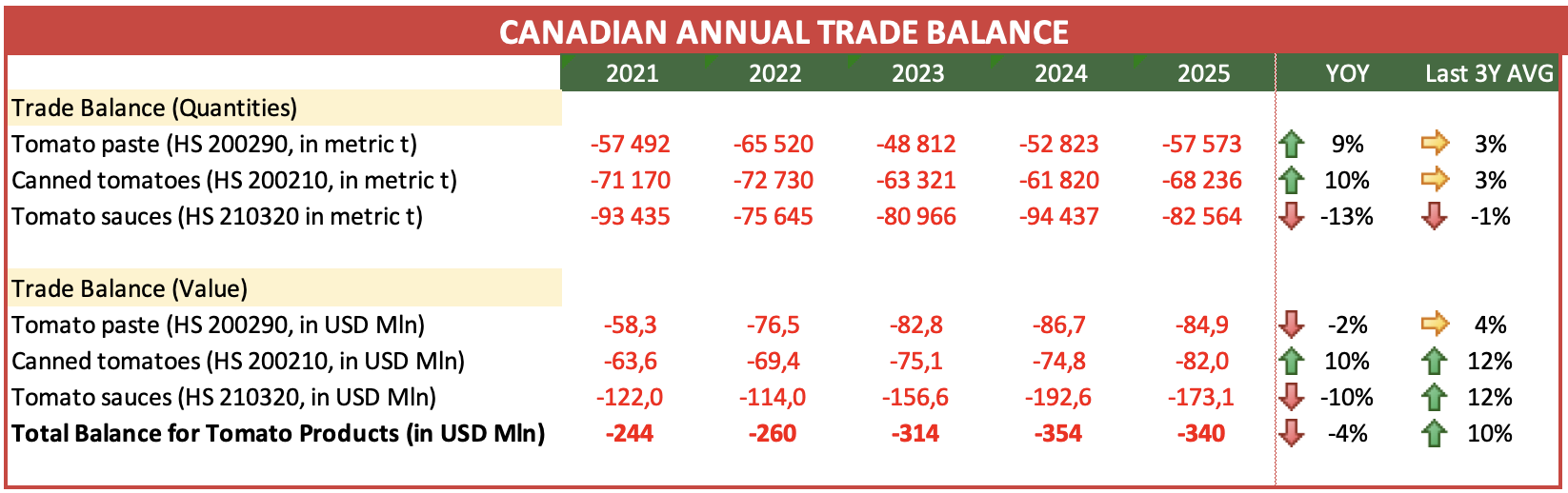
As shown by the Canadian trade data available on our website www.tomatonews.com, (Country Profiles) between 2021 and 2025, the Canadian trade balance for processed tomato products highlights a massive financial deficit.
The overall trade deficit appears to have stabilized since 2023, following a period of deterioration. Imported volumes are increasing for paste and canned tomatoes, while sauce imports decreased in 2025 following a record year for imports in 2024 (and a previous peak in 2021). However, the net value for tomato paste went down slightly, indicating that paste was imported at a lower price than the year before, likely due to the market surplus carried over from 2024.
While net imported volumes of sauces decreased by 13% this past year, the net value only dropped by 10%. This value resilience was mainly driven by persistent inflation and surging production costs accumulated in recent years.
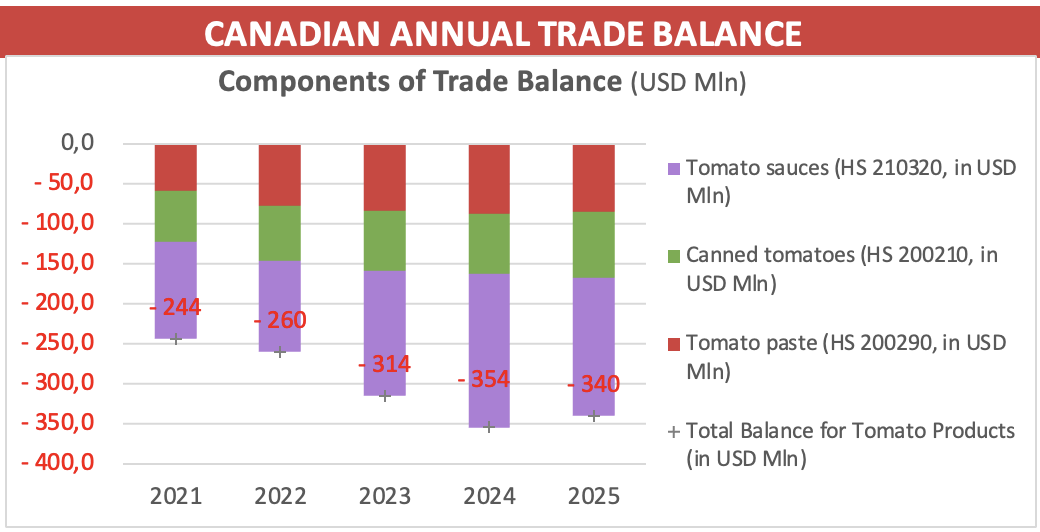
Since 2021, the average import price across all categories rose from USD 1,071 per metric tonne to USD 1,591 in 2025—a 33% increase overall. This growth was primarily driven by a 38% increase in the value of sauces, alongside increases of 31% for paste and 26% for canned tomatoes.
Dynamics by Product Category
Tomato paste (HS 200290) is the least imported category by volume, reaching 59,240 metric tonnes in 2025, returning to 2021 levels after years of fluctuations. It is also Canada’s least exported item, standing at 1,667 metric tonnes in 2025, near its lowest point since 2021.
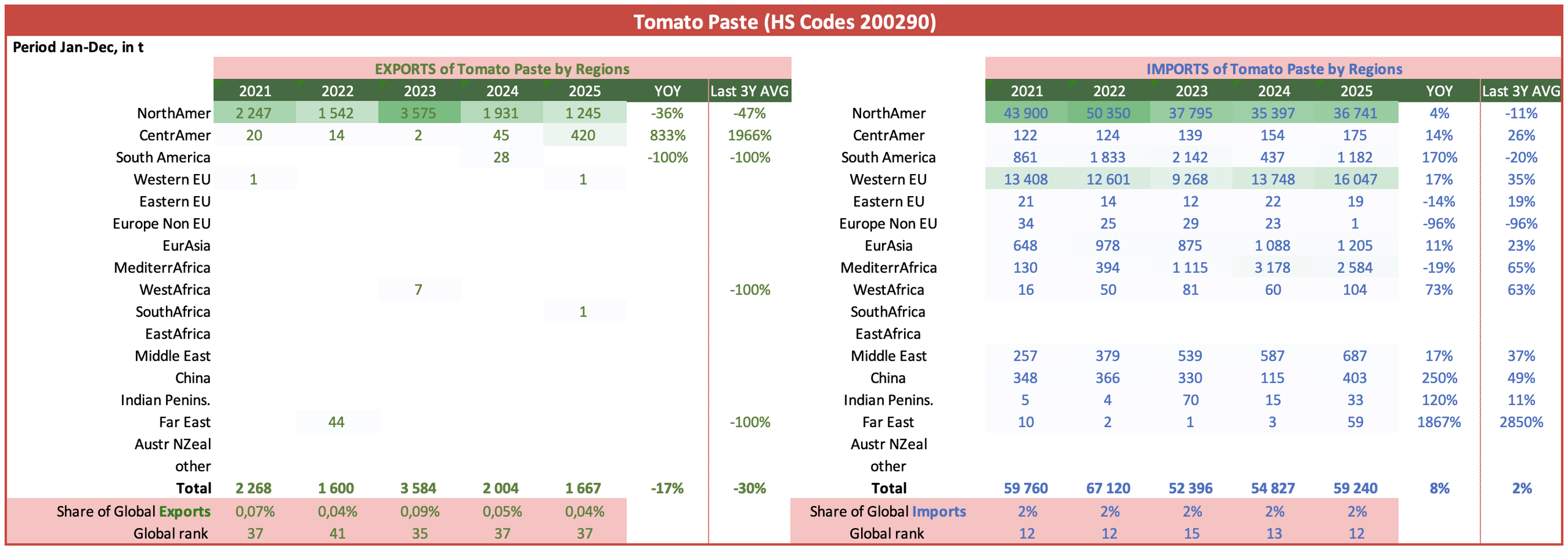
As both a producer and consumer, Canada trades primarily with its neighbor, the United States. While imports originate from multiple regions, Western Europe (with Italy accounting for 99%) serves as Canada’s second-largest supplier of tomato paste.
Canned tomatoes (HS 200210) account for 32% of total import volume. Following a sharp decline in exports in 2022, export volumes recovered and stabilized at 4,848 metric tonnes in 2025. On the import side, after a brief dip in 2023, volumes rose again to 73,084 metric tonnes in 2025.
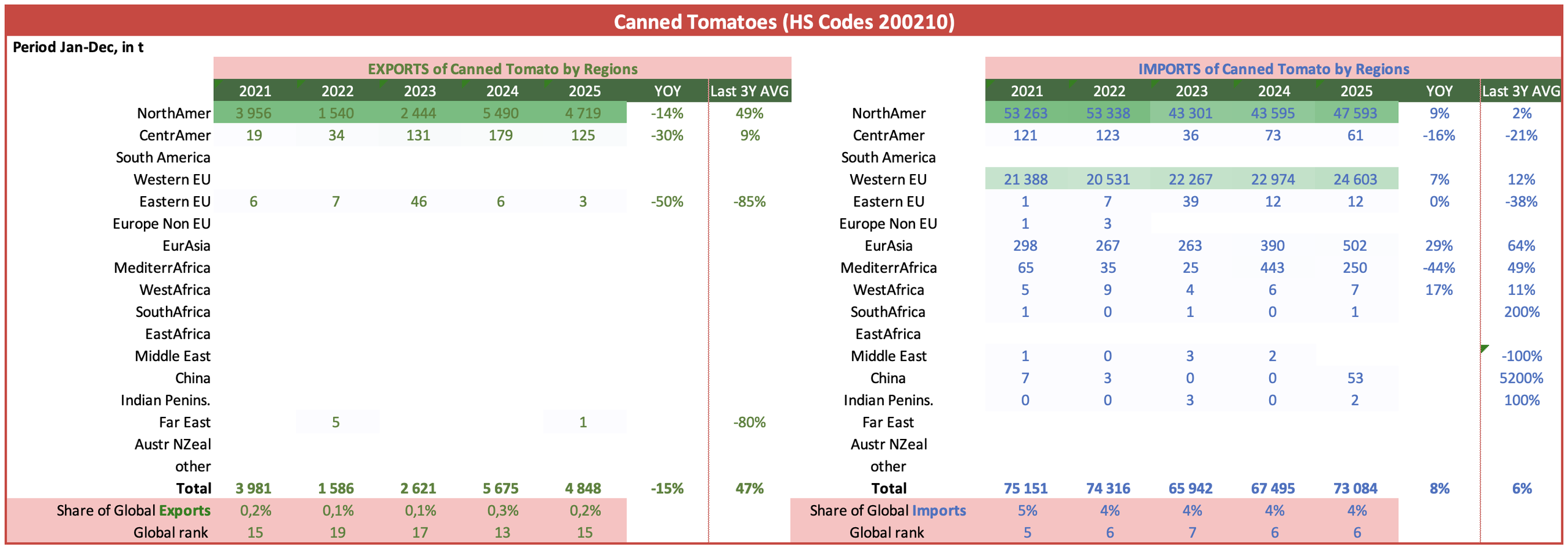
For this category as well, Canada’s primary trade partner is the United States. Imports are sourced globally, but Western Europe—specifically Italy (96%) and Portugal (nearly 4%)—is the second-largest supplier of canned tomatoes to Canada.
Canada ranks among the top ten global importers of canned tomatoes, currently holding 6th place with approximately 4% of global volume. Conversely, its role as an exporter remains minor, ranking between 13th and 19th worldwide with a market share between 0% and 0.3%.
Prepared tomato sauces (HS 210320) represent the largest category by import volume, accounting for 43% of total imports. In 2025, imports stood at 99,660 metric tonnes—the lowest volume recorded over the five-year period. However, this category drives the largest trade deficit, exceeding USD 173 million in 2025.
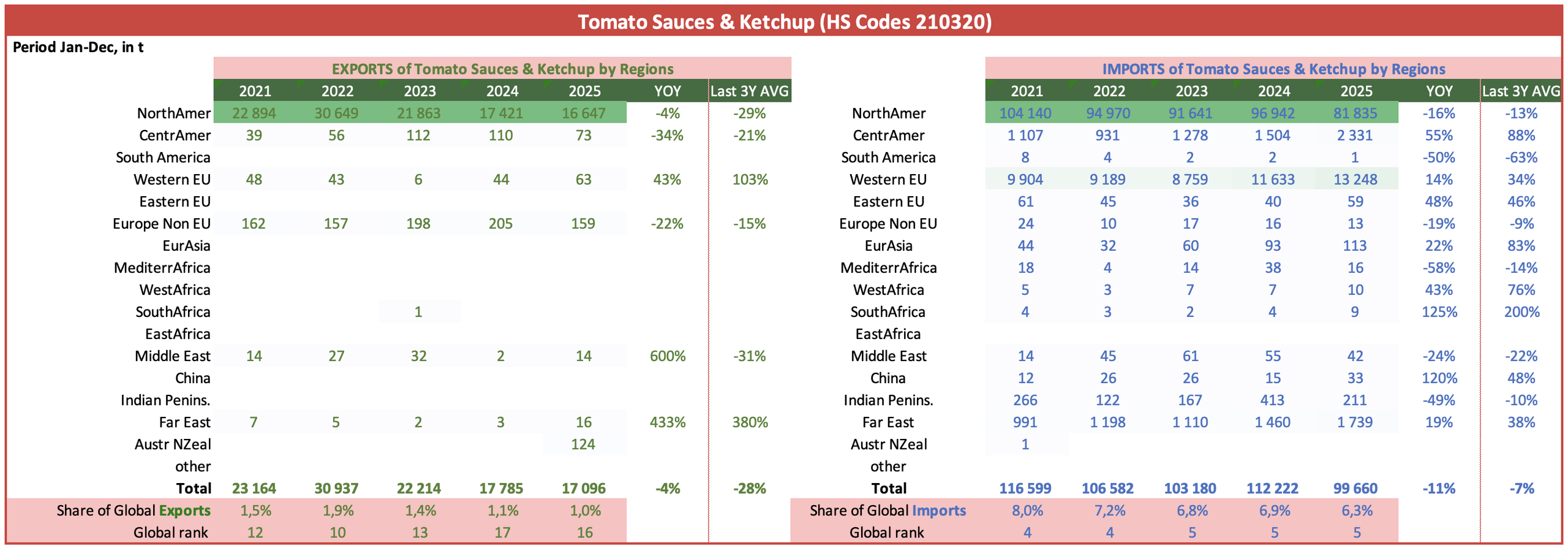
In the global market for tomato sauces and ketchup, Canada ranks as the 5th largest importer (representing 6.3% of the global market). Its role as an exporter remains secondary, ranking between 10th and 17th worldwide with a market share between 1% and 2%.
Between 2021 and 2025, Canadian sauce imports steadily decreased from 116,599 metric tonnes to 99,660 metric tonnes (-11% overall). The supply structure relies overwhelmingly on the United States (82%), followed by Western Europe at 13% (Italy making up 99%), Central America at 2% (Mexico making up 94%), and minor quantities from other regions.
On the export side, following a peak in 2022 at 30,937 metric tonnes exported primarily within North America, exports have adjusted to 17,096 metric tonnes in 2025, ranking Canada 16th globally.
Outlook and Summary
Canada’s processed tomato market remains characterized by a deep structural trade imbalance, relying heavily on the United States and Western Europe to meet domestic demand across all product categories. While total import volumes show signs of stabilizing or slightly contracting, particularly in prepared sauces, rising production costs and global inflation have kept import values high, sustaining a substantial trade deficit. Looking ahead, Canada’s limited processing expansion and secondary role as an exporter mean it will remain a vital destination for international suppliers, with future market stability closely tied to price trends and supply dynamics in the U.S. and European markets.
Furthermore, as the European Union proposes granting Canada a unprecedented “associate member” status, a deeper political and economic alignment could streamline transatlantic supply chains, providing European processors with even more stable, preferential access to the Canadian market while offering Canada greater regulatory integration and supply chain resilience beyond North America.
Consult the Country Profile of Canada here
Source: TDM