News
Welcome to the 16th World Processing Tomato Congress and the 18th ISHS Symposium on Processing Tomato.
We are very glad to welcome the global processing tomato community to Monterey and back to California. It has been more than twenty five years since this Congress was last held here, and Monterey feels like the right place for that return. At this time of year, it offers a milder setting than the interior valley and a side of California that many visitors may not know as well. It is also a place with its own agricultural and industrial history. Monterey was once known around the world for sardine canning. Today it sits next to one of the world’s leading centers of technology and innovation. California has a long history of changing with the times, and agriculture has had to do the same.
That has certainly been true in processing tomatoes. California remains one of the most important production regions in the world, but it has not held that position by doing things the same way year after year. Over time, this industry captured many of the big gains that reshaped modern production, mechanized harvest, better varieties, more targeted fertility and crop protection, the move from direct seeding to transplants, and the near complete shift to subsurface drip irrigation. Those changes transformed the crop and helped build the system that visitors know today. The work now is harder. It is about keeping a mature, high performing production system productive under tighter biological, economic, and regulatory constraints.
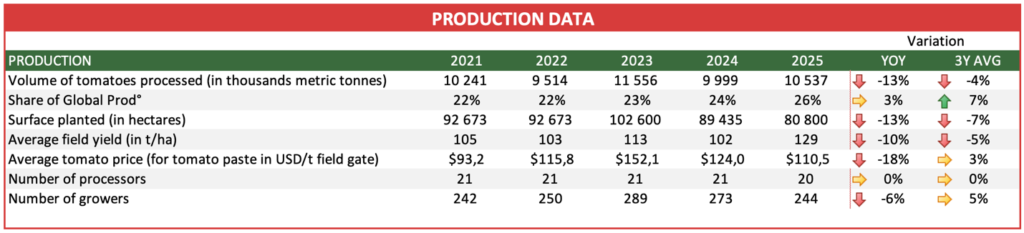
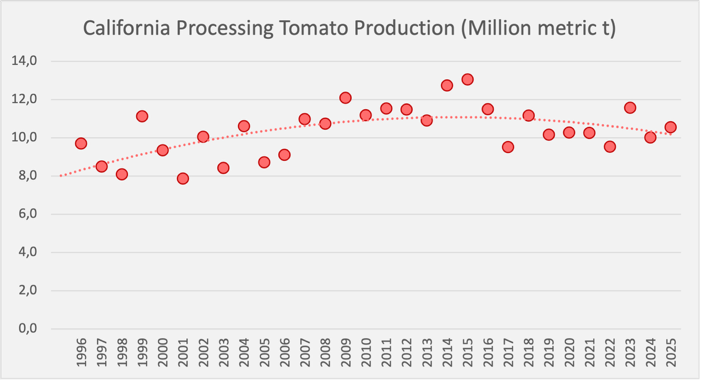
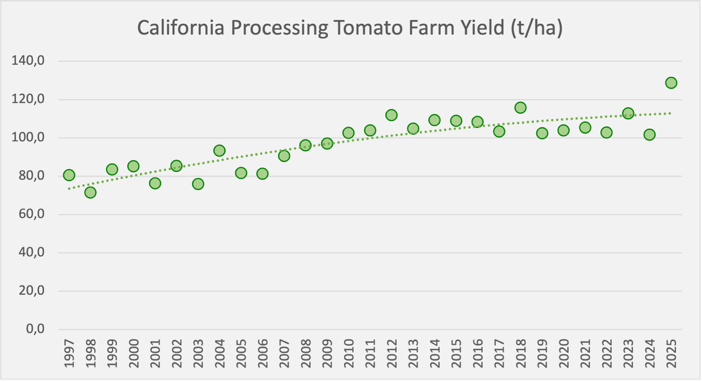
The 2025 season offered a useful reminder of both how strong this system can be and how much stress still holds it back in a typical year. Statewide average yield reached 56 tons per acre, more than 10 percent above the prior historical high near 49. Favorable environmental conditions played a major role, with limited transplant disruption, little heat stress during flowering and fruit set, and mild conditions through much of fruit development and harvest. No one should mistake that for a permanent breakthrough on its own. What it did show, very clearly, is that California’s yield ceiling is higher than many assumed. The harder question now is how much of that performance can be carried forward when the more familiar stresses return.
And those stresses are real. Water, labor, regulation, pests, diseases, and input costs all shape how acres are farmed and which acres remain competitive. These issues are not unique to processing tomatoes, but they define the operating environment for specialty crops in California. They also explain why the tomato industry here has become so disciplined. There is very little room for loose management. Success depends on timing, coordination, and a willingness to keep improving even when the system is already operating at a high level.
Water remains the clearest example. California processing tomatoes have already gone through one of the most important efficiency transitions in modern production agriculture through broad adoption of subsurface drip irrigation across nearly all acreage. That shift alone reduced water use dramatically compared to older irrigation systems, and in many fields the gains have gone further through better scheduling and deficit irrigation where field conditions allow. But water in California is never just a question of quantity. It is also a question of quality. In years when surface water is short, as growers expect again this season, more of the burden falls on groundwater. In some areas that means higher salts and lower quality water, which can directly affect both yield and fruit quality. So even where water remains physically available, the source matters. The challenge is not simply securing enough water to finish the crop. It is securing water of sufficient quality to protect productivity and quality at the level the market expects.
That issue will continue to shape the industry for years to come. SGMA is moving from policy into practical consequence. Groundwater restrictions are becoming more real, surface supplies remain uneven, and future planning increasingly has to consider return per acre foot of water, not just return per acre of land. Expanded groundwater recharge, water banking, and additional storage will help. Projects like Sites Reservoir and expansion of San Luis are part of that longer term picture. But no one in this industry is waiting for a simple fix. The California tomato business has already been learning how to operate inside tighter water limits, and it will keep doing so.
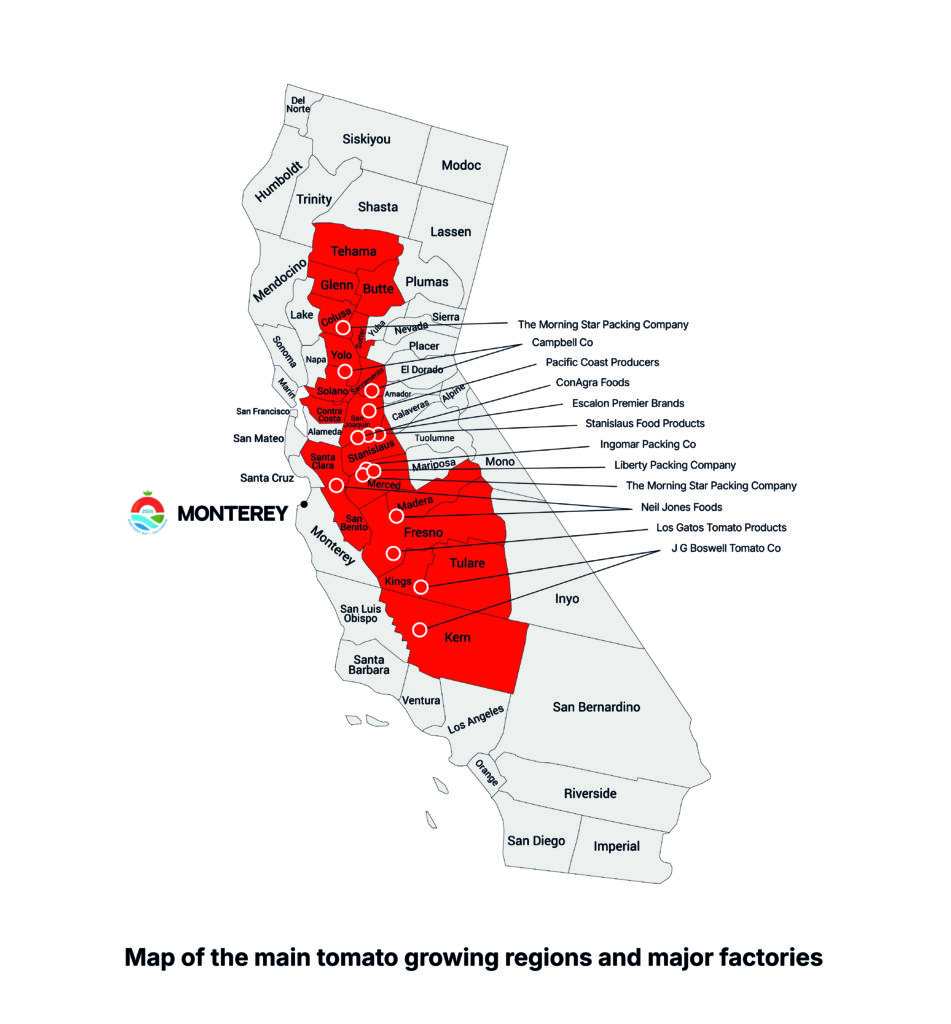
The processing side of the industry has adjusted as well. A handful of companies have exited over the past several years, helping bring production capacity into better balance with demand. What remains is a processor base of 10 companies and 16 facilities, including the largest processor in the world by volume and the processor with the highest number of canning lines in the industry. This is still a very large and highly capable system, and one of California’s advantages remains the tight connection between the field and nearby processing capacity.
Pest and disease pressure remain part of that practical reality every year. Broomrape has become the clearest recent example of an issue requiring broad industry attention. It is serious, but it is also an example of the industry working together in a concerted way toward research solutions, practical control, and long term management. The work is not finished, but progress has been real and the direction is encouraging. Broomrape sits alongside a wider set of pressures that California growers and advisers continue to manage, including root-knot nematode, fusarium stem rot and decline, tomato spotted wilt virus, beet curly top virus, and southern blight, to name a few. None of these issues is solved once and for all. They require constant adjustment in variety choice, diagnostics, water management, crop protection, field selection, and timing. One of the strengths of this industry is that growers, processors, PCAs, farm advisors, university researchers, and technical teams remain closely tied together in that work.
Automation belongs in this story too. California was the industry that first automated harvest in the 1960s, and it is now moving quickly again as transplanting and cultivation technology begin to match commercial needs. This season, more than a dozen automated transplanters are operating commercially up and down the state, along with roughly half a dozen automated weeders. More are already on order for next year. That is another sign that the industry may be at an inflection point where equipment is finally meeting the specifications, reliability, and price point needed for broader adoption.
California still benefits from something that is hard to replicate elsewhere, scale, nearby processing capacity, strong public and private breeding, applied research that stays close to commercial reality, and technical support that remains connected to the field. That does not make the path ahead easy. The next gains will be harder won. Some will come from genetics. Some will come from better management of water, stress, and plant health. Some will come from automation, diagnostics, and better use of data. But this industry has a long track record of adjusting when it has to, and that remains one of its strengths.
We hope your time in Monterey is productive, enjoyable, and worth the trip. We hope this Congress gives you a good sense of where California processing tomatoes stand today, of the pressures the industry is working through, and of the confidence the industry still has in its future. California has changed a great deal since this Congress was last here. So has the tomato industry. Bringing the global community back at this moment feels timely, and we are pleased to welcome you.
Welcome to Monterey, and welcome to California.
Article published in The 2026 Processed Tomato Yearbook distributed to all congress attendees.
It can also be purchased HERE