Myles Collinson received his bachelor’s degree at Cornell University in plant sciences with double minors in entomology and fungal biology. During his time at at Cornell, he managed the greenhouse space for the horticulture club Hortus Forum, assisted with research projects on late blight in potato with professor Bill Fry, and helped organize the first annual Bioblitz at the Cayuga Nature center; a 24 hour community science event aimed at categorizing as many species in an area as possible. After graduation he worked for 3 years in industry, breeding for disease resistance in Canola to black leg, clubroot, and sclerotinia white rot.
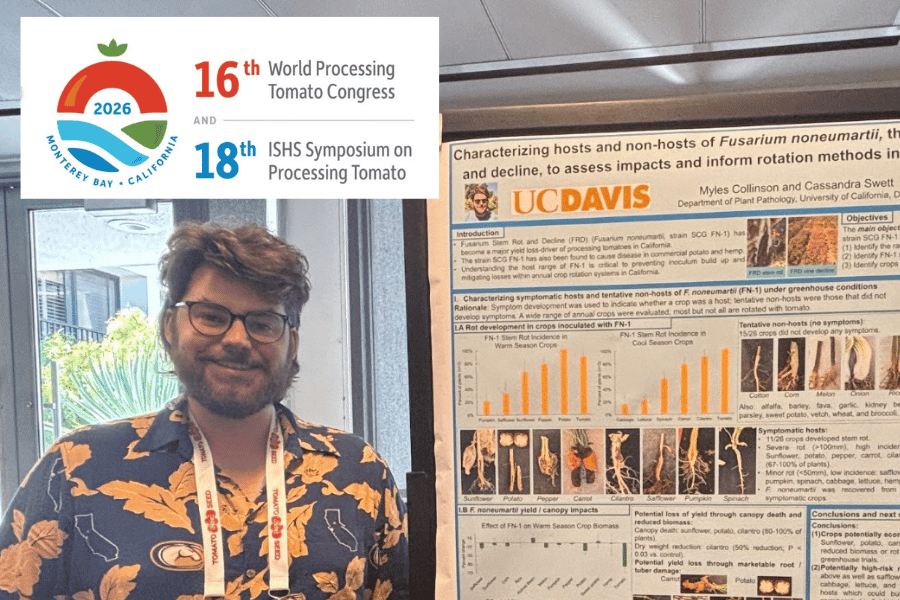
In 2021, he started a PhD at UC Davis with Dr. Cassandra Swett. His project focuses on developing integrated management strategies for the economically important disease of processing tomatoes; Fusarium stem rot and decline (FRD) caused by Fusarium noneumartii and F. martii. Through this project he has characterized the extensive host range of F. noneumartii in crops and weeds, carried out multi-year field trials to develop rotation guidelines informing growers on what crops to plant in rotation with tomato if they have FRD in their fields, and worked with industry breeders to develop more resistant processing tomato varieties. He presents at multiple cooperative extension meetings each year to share this work with the industry.
At the 2026 ISHS symposium on processing tomato, Myles presented on his FRD cultivar resistance work. He shared data from field trials demonstrating that the extended field holding trait (EFH) is connected to reduced fruit impacts and increased yield, and that the Fusarium crown and root rot resistance gene (FRL gene) has cross resistance with FRD (reducing incidence and severity of stem rot). He also presented on wild germplasm accessions that he found to be potentially completely resistant to F. noneumartii.
He received the Cosme Argerich Memorial Award in June 2026.