News
Research: Tapered deficit irrigation strategies can reduce water use
A new publication in California Agriculture exploring the impact of tapered deficit irrigation on processing tomato yield and quality highlights how strategic deficit irrigation can maintain crop performance while conserving water—an increasingly important tool for growers navigating limited water availability.
An average of 25 inches (635 millimeters) of water is currently used on processing tomato fields in California throughout the course of the season, bringing the annual average water use of processing tomatoes to 156 billion gallon593 million cubic meters). The Central Valley of California, particularly Fresno County, however, faces ongoing challenges with agricultural water shortages due to frequent drought. Over the past decade, many growers in the region have not received their expected surface water allocations, highlighting the persistent issue of water scarcity. This creates a difficult situation with high annual uncertainty, causing growers to use saline groundwater or fallow their fields. The low recharge, reduced leaching, and high agricultural groundwater use in Fresno County leads to challenges with salt accumulation and groundwater depletion, reducing the viability of supplementing surface water allocations with groundwater in future dry years. To comply with Sustainable Groundwater Management Act (SGMA) goals to reduce groundwater overuse and make the best of allocated water, growers need water-saving irrigation strategies.
In view of these, California processing tomato growers must adapt their irrigation management practices. Processing tomatoes’ water stress tolerance provides a water savings opportunity through deficit irrigation, although it is important determine how this can be done while maintaining yield and fruit quality.
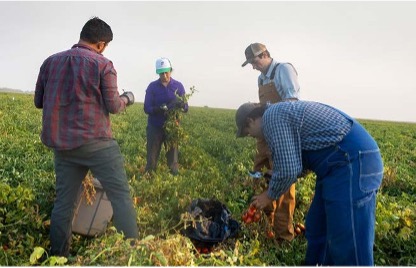
Authors Logan Ebert, Mallika Nocco, Andrew Gal, and Gaurav Jha harvesting a 2-meter transect
to collect tomato samples to estimate Brix and yield per replicate.? Photo: Dawson Diaz.
to collect tomato samples to estimate Brix and yield per replicate.? Photo: Dawson Diaz.
 In this research carried out by a team from UC Davis and UC Cooperative Extension, a deficit irrigation experiment was carried out over three years using a randomized block design with four treatments in three commercially operated fields in Fresno County. A tapered deficit treatment was applied, where the amount of water deficit was increased partway through the deficit period to ease the crop into higher water stress while further reducing irrigation.
Results presented show that in all three seasons, there were no differences between treatments in yield, with some seasons having an improvement in Brix with the higher deficit treatments. This was achieved with up to a 29% reduction in irrigation compared to the grower’s standard practice.
The tapered strategy seems to offer a balanced approach, maintaining strong performance in both yield and Brix while gradually increasing water stress to conserve more water toward the end of the season. The optimal deficit irrigation strategy may vary by cultivar, depending on factors such as the timing of fruit set, water stress response, disease resistance, and yield potential.
Since there was no reduction in marketable yield or Brix, the data supports the hypothesis that these parameters and water savings would improve or stay the same with the tested deficit irrigation strategies. Given increasing water scarcity in California, the study demonstrates that deficit irrigation using a tapering strategy is a commercially viable option for processing tomato growers with limited freshwater allocations and access to groundwater.
Reference:
Ebert, Logan A, Andrew Gal, Wesley Brooks, Thomas Turini, Gaurav Jha, Cristina Lazcano, Amélie C.M. Gaudin, Kate Scow, and Mallika A Nocco. 2025. “Tapered Deficit Irrigation Strategies to Reduce Water Use in Processing Tomatoes.” California Agriculture, May.
Full article accessible at: https://doi.org/10.3733/001c.138274
Cover photo by Logan Ebert