News
Portugal: Syngenta launches a fungicide to prevent mildew in tomatoes
Orondis Ultra is a new fungicide launched by Syngenta, specific against downy mildew (oomycetes) and particularly useful for preventing downy mildew on tomatoes. As well as mandipropamide, the product contains oxathiapiproline, "an active ingredient from a new chemical group with a new mode of action," according to a Syngenta statement.
According to Syngenta, which presented this new product at the Syngenta Processing Tomato Technical Meeting, held on February 7 at CNEMA, Santarém, "this dual technology acts synergistically, effectively protecting leaves, fruit and new tomato shoots at very low doses (12-20 grams/hectare/year)."
"By combining the action of the two active substances, Orondis Ultra acts in a translaminar way on the leaves of the plants with a systemic effect, resistant to leaching by rain as early as one hour after application. It is an excellent tool to integrate into a fungal resistance management strategy," says the company.
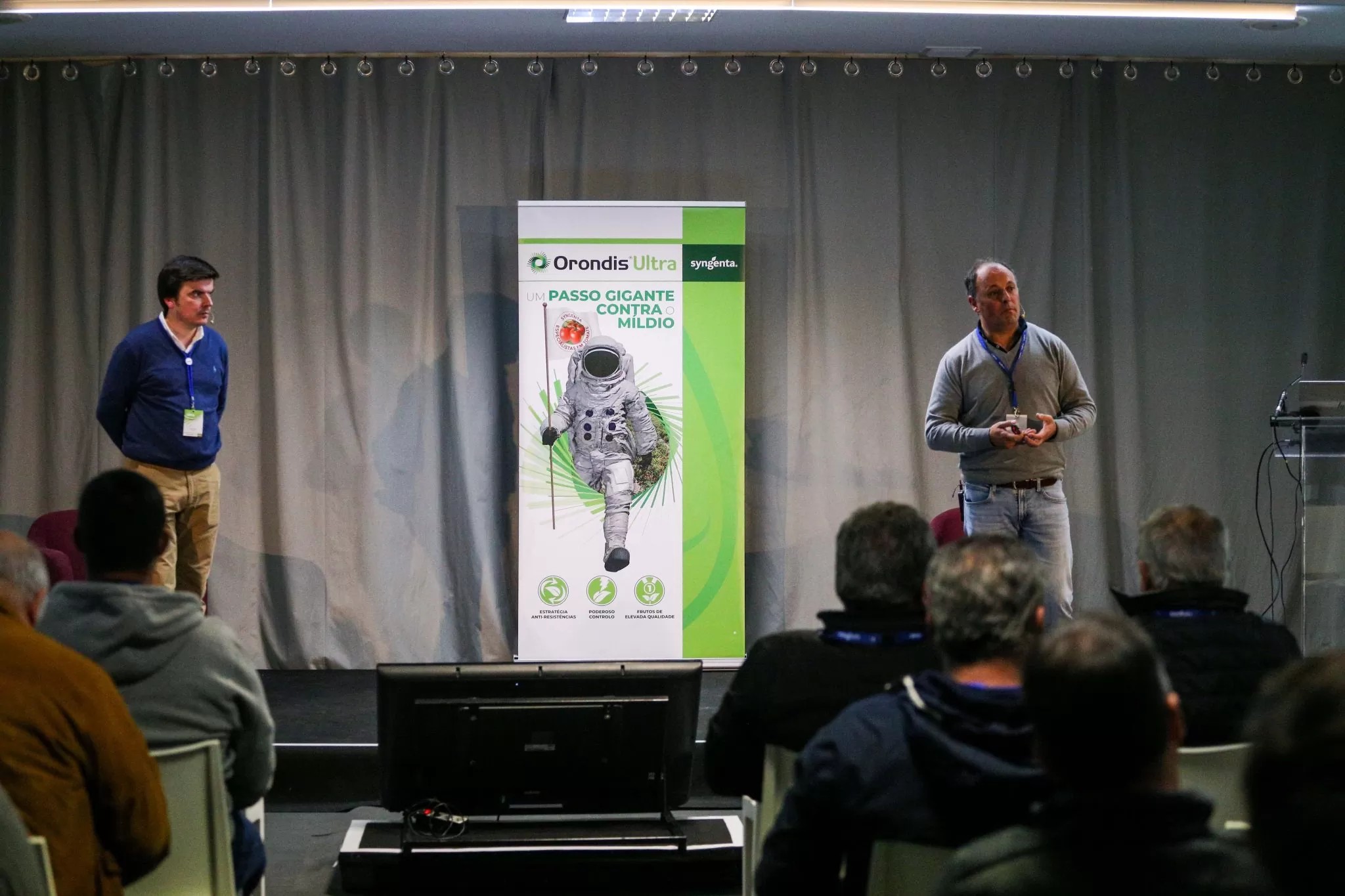 Syngenta also states that "applications of Orondis Ultra should be made preventively, from vegetative development to early ripening, with an interval of seven to ten days." Nuno Zibaia, Syngenta Customer Accounts Manager for the Ribatejo region, says that "Orondis Ultra is a diamond that we are putting into the hands of growers, with a new and powerful molecule – oxathiapiproline – which is why we must preserve its effectiveness by always using it preventively."
The Syngenta Processing Tomato Technical Meeting, which brought together around 100 growers and technicians, provided a good opportunity to publish the results of a spray test on processing tomatoes, in Lezíria de Vila Franca, carried out by Ag-Innov (Agricultural Center of Excellence of the Ortigão Costa Group) in 2021 in fields owned by the Sogepoc Group, in partnership with Syngenta, the National Horticultural Operational and Technological Center (COTHN) and Smart Farm Colab – the Collaborative Laboratory for Digital Innovation in Agriculture. Syngenta says the conclusions of the trials demonstrate that "a 25% reduction in the volume of solution, with the same dose of active ingredient, does not affect the efficiency of the crop protection product applied and reduces the environmental impact."
This trial was also an opportunity to underline that "it is important to consider the use of 'anti-drift' nozzles, the installation of an air sleeve on the sprayer boom and the respect of a maximum height off the ground of 50 cm during treatments. It has already been demonstrated that these practices help deposit a greater amount of product on the target (plants and fruits) and therefore increase the effectiveness of the treatments." In terms of processing tomato crops, Syngenta claims to hold a "20 percent market share in protection solutions" for this crop in Portugal and has "strong arguments for consolidating this position." Paulo Machado, Commercial Director of Syngenta in Portugal and Galicia, emphasizes that "our portfolio of solutions meets the needs of the market", that "we have the best team and business partners" and that "we want to continue being the go-to reference brand for processing tomato crops."
The event also welcomed the promoters of the "Projeto Tejo", an initiative "with multiple goals, aiming to make water permanently available in the Tagus, in sufficient quantity and quality for different uses, from tourism to agriculture." Manuel Campilho, Miguel Campilho and Jorge Froes presented the added value of this initiative, considering that "for the Baixo Tejo, the main production area for processing tomatoes, the implementation of the 'Projeto Tejo' will allow the irrigation of 210,000 hectares, practically eliminating the need to pump water from the river to irrigate fields," as reported by Syngenta.
Some complementary data
For more information on the Projecto Tejo, click here and here
Sources: flfrevista.pt, agriculturaemar.com