News
California: now is not the time for expanding capacity
2021 Season
On April 29, 2021, in its newsletter The MorningStar Packing Company published an open letter by Chris J. Rufer titled “California Processing Tomato Industry Situation”, in which the owner of the company explains how the California processing tomato industry has a history of meaningful ups and downs in production volumes, prices and profitability–as almost all industries do. Some of the key points made in this document are summarised in this article.
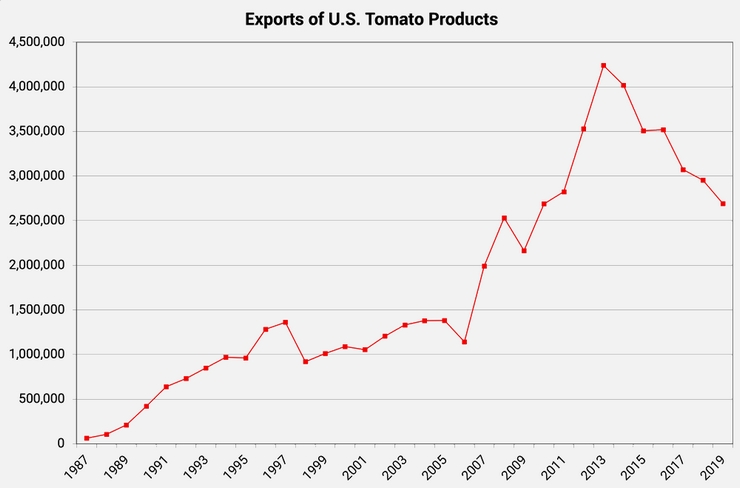
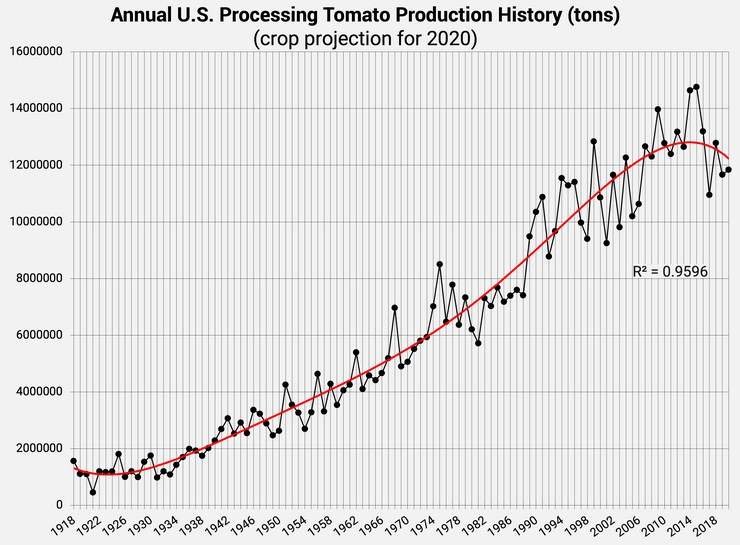
 “We (The Morning Star Packing Company) made a significant expansion in 2015, which left us with high inventories and excess capacity. As one can easily see in the following chart, market volumes were increasing pretty well from exports leading up to 2014 and 2015. A few factors lead up to this growth.
In the prior five years, production in the European area decreased, China finally realized its losses and consolidated considerably and the Euro/Dollar relationship changed in favor of U.S. exporting. But then things changed again. The European area and China stabilized production, the Euro dropped from the 135 (dollars per Euro) range to under 110, plus smaller world producers (e.g., Ukraine, Russia and Tunisia) increased production.
California tomato paste exports have been in free fall ever since.
In 2014 when I decided to expand, I reasoned that if the exports did not rise as fast or as they had been up to that point, or if they even dropped, we could use our increased capacity to shorten the length of our season. By doing this, we could eliminate some late-season premiums to pay for the investment partially.
Since 2015, our industry has fought very high inventories and over-capacity. However, the 2020-2021 years saw four factories close and two companies exit the business. All four of these shuttered factories (Hunts in Helm, both Olam (former SK Foods) factories in Lemoore and Williams plus Mizkan (Ragu) in Stockton), had structural cost problems. With these closures, the industry has found new footing with a good balance of market volume requirements, inventory and capacity.
Since 2015, our industry has fought very high inventories and over-capacity. However, the 2020-2021 years saw four factories close and two companies exit the business. All four of these shuttered factories (Hunts in Helm, both Olam (former SK Foods) factories in Lemoore and Williams plus Mizkan (Ragu) in Stockton), had structural cost problems. With these closures, the industry has found new footing with a good balance of market volume requirements, inventory and capacity.
As can be seen in the next graph, the market size for our processed tomato products has flattened. There is solid, stable demand domestically, and at some point in time, exports will also level off at some lower level. We are clearly dependent on export potential for any volume growth and at more risk for volume losses from decreased exports. These are markets very reliant on prices, but just the Euro/Dollar improving in our favor will not be enough to correct our competitiveness relative to other world producers.
When an industry is experiencing an increase in market demand, prices are generally higher than cost structures and cycles from bottom to bottom are shorter. When market demand is flat, or especially when it is decreasing, these cycles are longer, and a depressed market situation for producers seems never to end (with prices barely above variable costs).
The California processing tomato industry is now in this same flat to decreasing market demand, shown in the following table,
Now is not the time for expanding capacity–it is a death sentence for those who do.
The California processing tomato industry is now in this same flat to decreasing market demand, shown in the following table,
Now is not the time for expanding capacity–it is a death sentence for those who do.
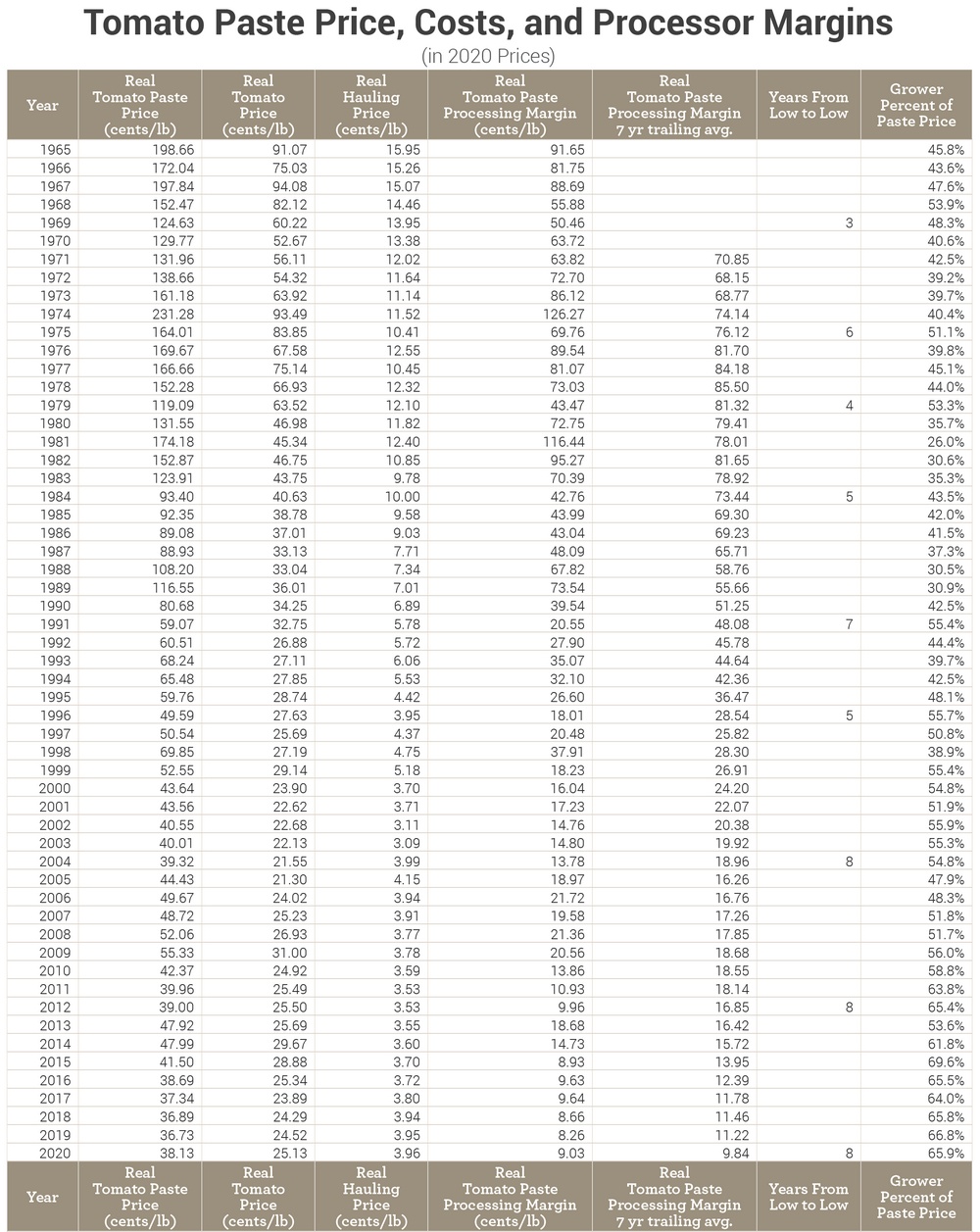
However, some nuances drive these trends and make the ups and down accentuated–which is what is going on today and which everyone should carefully consider.
To review the ups and downs drivers, let’s begin the scenario with an industry situation of short inventories and balanced capacities (like we are at now). While buyers of our products don’t admit it during our periods of languishing prices, excess inventories, and hungry processors, reliable supply is far more important to them than price, which explains why, when there is a hint of a supply shortage like now, prices spike.
During this period of low inventories and price hikes, the key nuance is that buyers over-book their requirements. When buyers perceive the potential for a short supply, they try to cover themselves by asking for more product than they truly require. “The industry” now sees a total “increase in demand”–which is all phantom demand. This activity also increases prices even more than the supply and demand balance would dictate to the degree this activity occurs.
At this point in the industry cycle, the result of this scenario is that producers are encouraged by phantom demand and high prices to expand
Of course, when this expansion occurs, it over-corrects and we over-produce–in spades, and prices decrease.
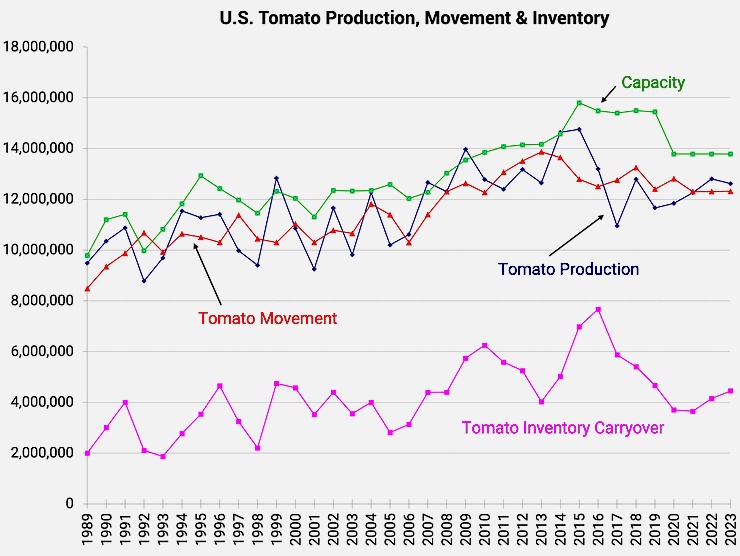
While current and short-term inventories are low in the industry cycle, the industry evidence is such that the low inventories are at a “normal” low for the cycle. Even if the crop is slightly below current expectations, we should have enough to get by.
Prospectively, any additional production capacity put online at this time for additional ingredient tomato paste or diced tomato production will cause a fast and significant build-up in inventories and another quick industry depression. Producers should look to increase hours of production in 2022 to make up for moderately short inventories coming out of the 2021 season–not adding additional capacity.
In summary, in my opinion, the California processing tomato industry is in a perfect balance of market demand and production capacity. A higher than fundamental supply/demand balance would drive prices and additional capacity brought online.
As needed, current capacity can operate for an extra 156 hours in 2022 (almost exactly one (1) week) to produce an extra one (1) million tons, which is very doable.
I think Warren Buffet’s “genius” is not so much in his given intellectual genius, but in his discipline–when things get good, hold on, build your cash and wait for other opportunities–they’ll come and sometimes out of nowhere.
Respectfully yours,
Chris J. Rufer, The Morning Star Company
The complete document is available at:
https://www.morningstarco.com/california-processing-tomato-industry-situation/
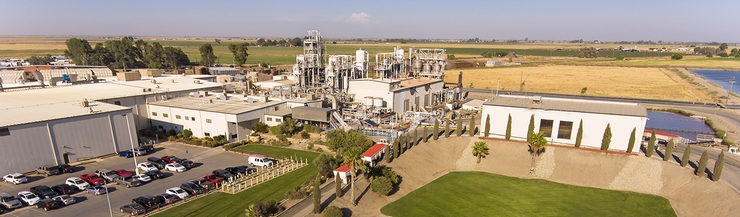
Source: The Morning Star Packing Company