News
USA: major changes observed in the sauces trade-flow
The combination of sluggish growth in foreign sales and an acceleration in imports has led to a significant erosion of the surplus. The rise in imports has a direct impact on apparent disappearance of Californian bulk paste.
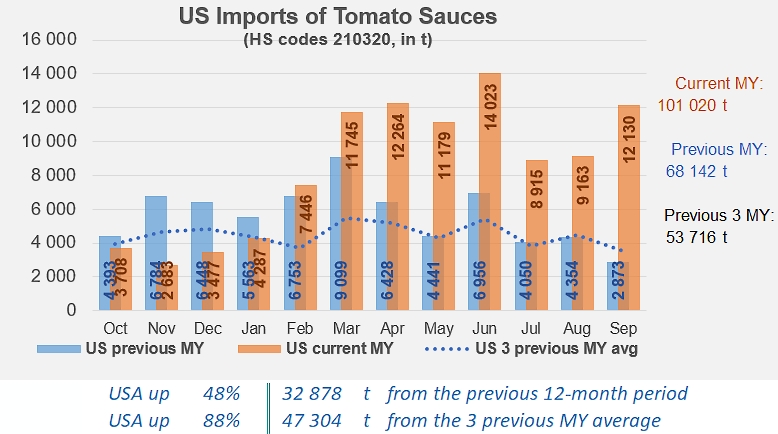
Over the last six months, the monthly tracking of imports of tomato products published on our Tomato News website (see also additional information at the end of this article) has shown a sharp increase in the quantities of tomato sauces and ketchup entering the United States. By way of comparison, US imports of sauces for the current year (October 2022 – September 2023) total just over 101,000 tonnes (t), up 48% against the same period last year (68,100 t) and 88% on the average of the previous three years (53,700 t).
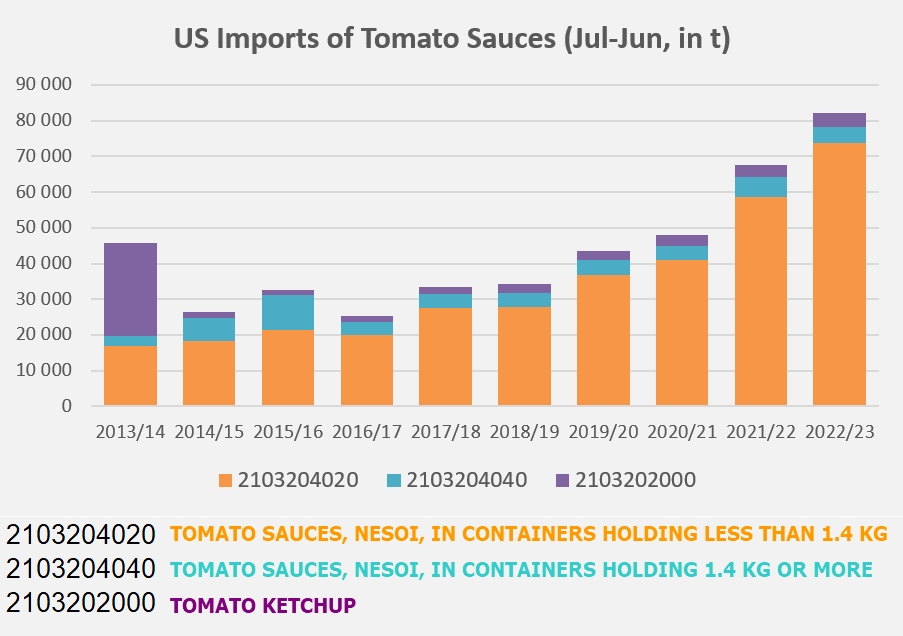
The results for the marketing years ending in June 2023 show that annual imports (July-June) rose from just over 25,00 tonnes in 2016/2017 to over 82,000 t in 2022/2023, and the quantities mobilized over the first four months of the 2023/2024 marketing year (July-October) do not buck the trend: with a total of 47,000 t, shipments recorded an increase of almost 200% on the average level for the last three years (15,900 t).
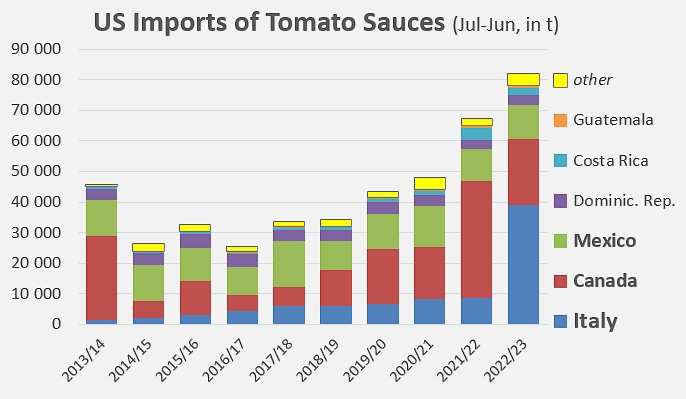
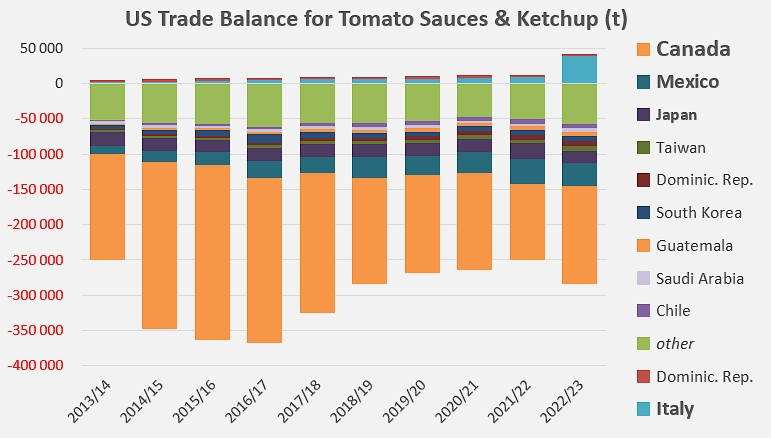
Italian products are the main beneficiaries of US consumers' craze for branded sauces, to the detriment of Canadian products, which have nonetheless seen significant growth in recent years, and, to a lesser extent, to the detriment of Mexican products. Since the 2016/2017 marketing year, when the US sauces trade balance reached its maximum surplus with almost 359,000 t of finished products exported, purchases of Italian products have grown at an average annual rate (CAGR) close to 45%, faster than the average annual increase recorded by products of Canadian origin (around 26%). At the same time, exports of US sauces to Canada have declined sharply, while sales to Italy, already extremely marginal six years ago, have almost completely disappeared.
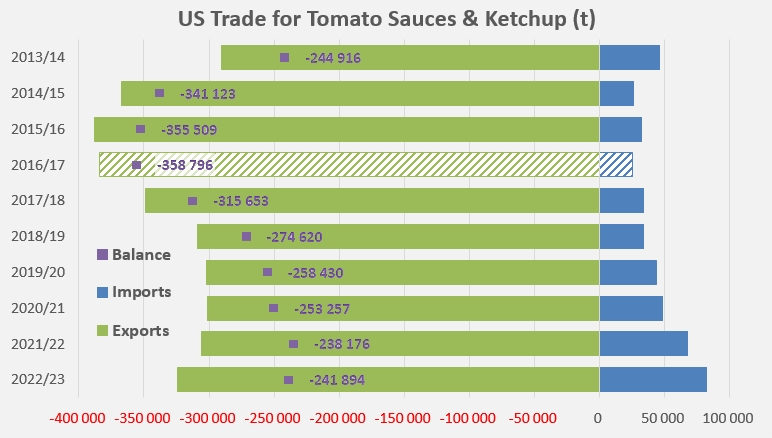
All in all, the US industry remains in surplus on all its sauces trade. The sector's US trade balance showed a positive export result of 242,000 t in 2022/2023. But the combination of sluggish growth in foreign sales and an acceleration in imports has led to a significant erosion of this surplus, which lost almost 117,000 t between 2016/2017 and 2022/2023. Performance in terms of quantities for the last marketing year was therefore 14% down on the pre-Covid period.
This gradual deterioration (CAGR -6.4%) in foreign operations has also had an economic cost, with a contraction in sales estimated at around USD 147 million over the period under review. So the USD surplus generated in 2022/2023 was 25% lower than in the pre-Covid period.
This gradual deterioration (CAGR -6.4%) in foreign operations has also had an economic cost, with a contraction in sales estimated at around USD 147 million over the period under review. So the USD surplus generated in 2022/2023 was 25% lower than in the pre-Covid period.
And, according to the operators themselves of the US processing industry, this regular and spectacular rise in sauce imports has a direct impact on agro-industrial activity. “The increase in U.S. imports of retail tomato products from outside of NAFTA is now becoming a matter of concern. In the past, retail imports would simply be categorized as ‘other than tomato paste’, which made sense when the majority of the retail imports were primarily whole tomatoes (particularly of the San Marzano variety) or diced & crushed type products”. These products did not constitute a category likely to compete with or impact on the Californian industry's flagship products – tomato pastes.
"The Pomi products in Tetra Pak packaging were a good example of these products, as well as several different brands of San Marzano tomatoes. These products were viewed as being high-end, ‘niche’ items that appealed to consumers who were still doing at-home cooking of sauces and wanted ‘real’ Italian tomatoes.”
“However, there has been a very strong surge in imports of prepared sauces from Italy,” in particular products destined for the retail trade, imported under customs codes 2103204020 (tomato sauces, in containers of less than 1.4 kg), which today account for 90% of incoming shipments of sauces & ketchup and can now be easily found “at a local store in Sacramento.”
“California and all US consumers are seeing the presence of genuine ‘Italian brands’ expand in the tomato section of grocery stores – not just in smaller ‘niche’ retailers – but in major chains such as Safeway. There are sauces, purees and ‘Polpa’, and also whole tomatoes and diced tomato items, but sauce type items occupy the majority of the shelf space.”
“For all Italian imports, it seems that the driving force behind consumer demand is perceived product quality. Tomato products produced in Italy are still perceived by many as being of superior quality to those produced in California or the Midwest.” Local sources have stated Gen Z consumers, and even those from previous generations Y and X, “are prepared to pay a premium for what they perceive to be a higher quality product.”
"The Pomi products in Tetra Pak packaging were a good example of these products, as well as several different brands of San Marzano tomatoes. These products were viewed as being high-end, ‘niche’ items that appealed to consumers who were still doing at-home cooking of sauces and wanted ‘real’ Italian tomatoes.”
“However, there has been a very strong surge in imports of prepared sauces from Italy,” in particular products destined for the retail trade, imported under customs codes 2103204020 (tomato sauces, in containers of less than 1.4 kg), which today account for 90% of incoming shipments of sauces & ketchup and can now be easily found “at a local store in Sacramento.”
“California and all US consumers are seeing the presence of genuine ‘Italian brands’ expand in the tomato section of grocery stores – not just in smaller ‘niche’ retailers – but in major chains such as Safeway. There are sauces, purees and ‘Polpa’, and also whole tomatoes and diced tomato items, but sauce type items occupy the majority of the shelf space.”
“For all Italian imports, it seems that the driving force behind consumer demand is perceived product quality. Tomato products produced in Italy are still perceived by many as being of superior quality to those produced in California or the Midwest.” Local sources have stated Gen Z consumers, and even those from previous generations Y and X, “are prepared to pay a premium for what they perceive to be a higher quality product.”
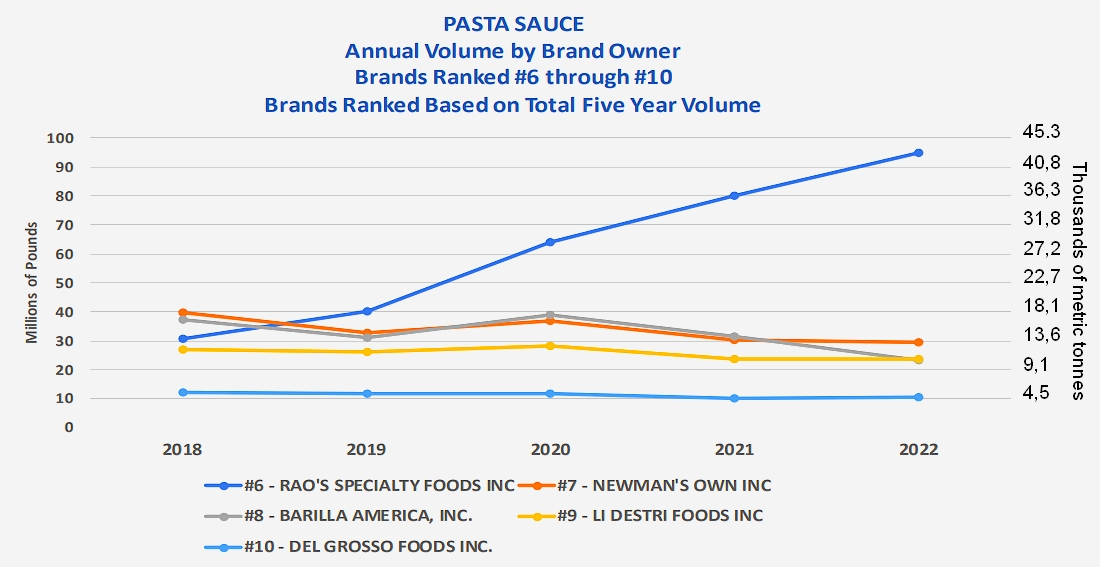
The extent of this emerging dynamic has evolved over the last few years in line with manufacturers' perceptions of it. When analyzing US supply and demand, imports in the sauces & ketchup sector were until recently counted as any tomato product not falling into the "paste" category. “But the reality is that these imported sauce products must actually be considered from the point of view of their equivalence in ‘bulk paste’, for the reason that these products would have been produced from bulk paste if they were being sourced from U.S. suppliers. So the growth of the Rao's brand has directly displaced potential bulk paste movement within the U.S. Mutti's Passata and Polpa are another good example.”
Some California processors “are beginning to believe that this increase in sauce type imports is the reason that [they] see U.S. consumption of bulk paste flat to declining, while overall U.S. consumption of processed tomato products appears to be stable to slightly increasing.”
Some complementary data
US imports of sauces for the current year compared with the same period of the previous year and the three previous years.
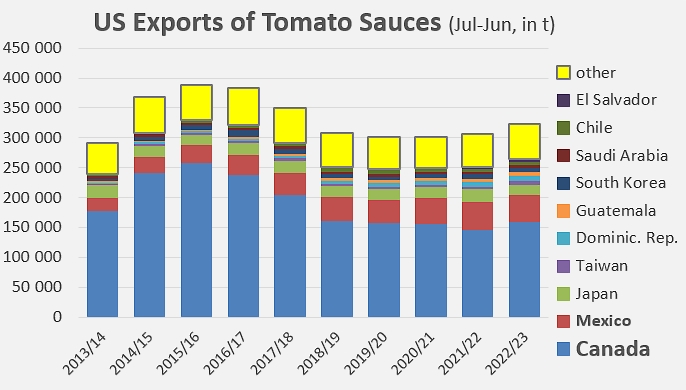
Evolution in US trade (exports and imports) in sauces and ketchup, by origin.
Evolution and composition of US imports of sauces & ketchup, by category (HS codes).
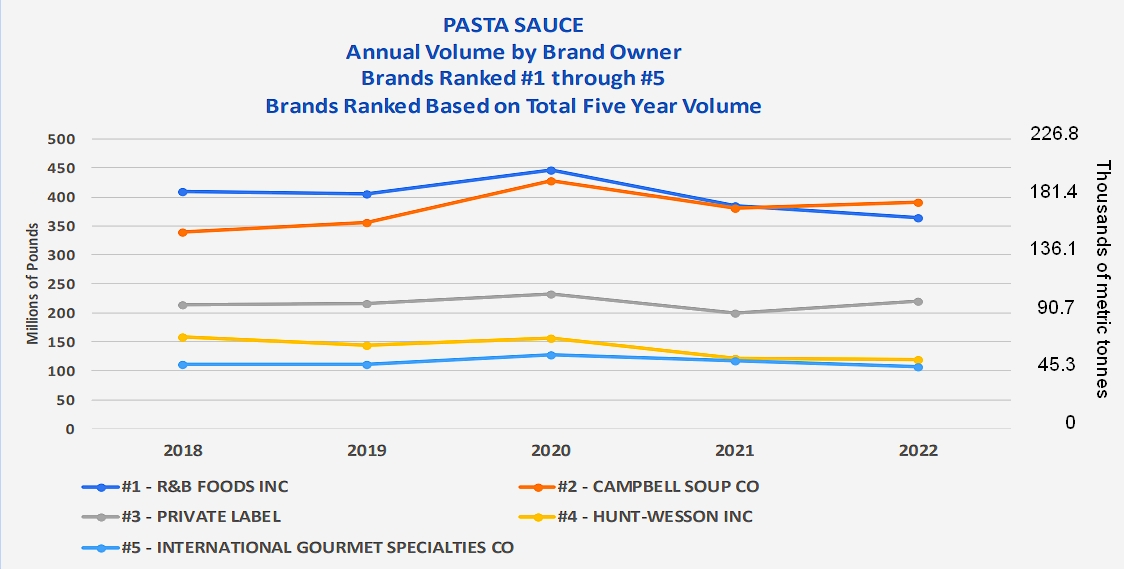
Annual sales volume by brand owner, brands ranked #1 to #5, based on total volume over five years.
Source: Trade Data Monitor, professional sources