News
ToBRFV: latest update
The tomato virus eradicated in France
The worldwide crisis linked to the coronavirus pandemic has temporarily eclipsed the more discreet issue of the disease caused by the Tomato brown rugose fruit virus (ToBRFV). Yet progress has been made and several decisive steps have been taken since mid-March, the last of which leads to the conclusion that the virus has been eradicated in France.
April 8, 2020
ToBRFV found on Egyptian import tomatoes in the Netherlands
The Tomato brown rugose fruit virus (ToBRFV) has been found in the Netherlands on imported tomatoes from Egypt. This is evident from the latest update of the international plant health organization EPPO. The same update also reports about an Italian find on imported tomato seed from Israel. Also mentioned is an initial contamination in bell peppers in Italy by the British Society for Plant Pathology (BSPP).
Reports about ToBRFV finds on import seeds have already been reported recently, but the find on import tomatoes is new. According to the NVWA, the find was made in November 2019 and is part of a series of finds, the Dutch food safety watchdog told Vegetables & Fruit.
The number of ToBRFV finds among growers in the Netherlands has not changed. That number remains provisionally at 19 finds and 3 serious suspicions. As far as is known, the contaminated imported seed that has recently been found in the Netherlands, comes from at least three different sources and was destroyed after it was found at Dutch customs.
ToBRFV found on Egyptian import tomatoes in the Netherlands
The Tomato brown rugose fruit virus (ToBRFV) has been found in the Netherlands on imported tomatoes from Egypt. This is evident from the latest update of the international plant health organization EPPO. The same update also reports about an Italian find on imported tomato seed from Israel. Also mentioned is an initial contamination in bell peppers in Italy by the British Society for Plant Pathology (BSPP).
Reports about ToBRFV finds on import seeds have already been reported recently, but the find on import tomatoes is new. According to the NVWA, the find was made in November 2019 and is part of a series of finds, the Dutch food safety watchdog told Vegetables & Fruit.
The number of ToBRFV finds among growers in the Netherlands has not changed. That number remains provisionally at 19 finds and 3 serious suspicions. As far as is known, the contaminated imported seed that has recently been found in the Netherlands, comes from at least three different sources and was destroyed after it was found at Dutch customs.
6 April 2020
The tomato virus eradicated in France
A few months ago, it was learned that ToBRFV, a highly contagious virus that renders tomatoes unfit for human consumption, had contaminated French farms.
All tomato sectors – both table tomatoes and processing tomatoes – feared the worst: a generalized contamination of crops that would have led to economic and social catastrophe for the industry as a whole.
Contaminated greenhouses, located in northwestern France and belonging to the Saveol Company, had received contaminated plants from Great Britain. Drastic measures were immediately implemented to avoid any propagation of the virus, and these were perfectly effective.
 “Confinement measures to control the tomato industry were successful,” happily stated André Bernard, President of the SONITO and of the Provence-Alpes Côtes d’Azur Chamber of Agriculture in southeastern France. “The tomato virus was detected, the contaminated greenhouses were confined, and the plants were destroyed. And now, for the past three weeks, we have had no further report of infection.”
Despite the announcement, the tomato industry remains on the lookout: “Although the seeds are still being controlled before arriving on French soil, the procedure is less severe regarding plants bought by greenhouse growers in France,” explained André Bernard. But he believes that they could still be a risk from plants bought by individuals for their private vegetable gardens.
1 April 2020
Seed from multiple countries contaminated
At least three sources of ToBRFV in Dutch tomato crops
Multiple seed lots from China, Israel and Jordan have tested positive for the Tomato brown rugose fruit virus (ToBRFV). The Dutch food and commodities authority (NVWA) stated earlier that a lot of tomato seed from Peru tested positive for the virus. Now it also concerns bell-pepper seeds and hot-pepper seeds.
In total, 19 instances of the virus have been identified with Dutch tomato growers. Contaminations among plant breeders have not been found. Inspections and tracing research are continuing. "For the tasks in the field of plant health, the NVWA primarily handles reports and incidents", stated an NVWA spokesman. "Of course, the guidelines for preventing the spread of the virus are being followed."
At Schiphol Airport, the NVWA and customs services intercepted seed consignments without phytosanitary certificates, imported from Jordan, and tested all these lots. They all tested positive for ToBRFV and were destroyed immediately. The European Plant health decree 2016/2031 states that plant products like seeds must have a phytosanitary certificate upon entering the EU. "The discovered seed lots did not", says the spokesman. "So we don't know the seeds' background."
In response to reports from tomato growers and the tests that followed, two recent tomato growers are suspected of being responsible. The number of positive identifications and suspected occurrences of ToBRFV among tomato growers has now reached 19 positive identifications, with a further three being suspected.
The NVWA tests a minimum of three months after the planting of the crop, if the contaminated growing companies provide disclosure. At the breeding stage, ToBRFV has not yet been found. The analysis of records of Next Generation Sequencing (NGS), in which the full RNA of the virus is mapped, suggests at least 3 different sources of contamination among Dutch tomato growers.
Reporting obligation
Since 1 November 2019, ToBRFV is marked as a control-required organism (quarantined organism). For this reason, there is a reporting obligation for everyone who has a suspicion of the presence of this virus. Not reporting is an offence, and the NVWA will enforce applicable measures.
4 March 2020
Italy: a validation protocol for testing is being set up
In just a few years, the Tomato brown rugose fruit virus has become a major problem for all sectors linked to tomato cultivation. At the beginning of March, the Italian virologist Walter Davino explained how to manage the problem presented by the occurrence of this virus.
Italy: a validation protocol for testing is being set up
In just a few years, the Tomato brown rugose fruit virus has become a major problem for all sectors linked to tomato cultivation. At the beginning of March, the Italian virologist Walter Davino explained how to manage the problem presented by the occurrence of this virus.
“We must manage the issue by carrying out analyses throughout the supply chain, beginning with the seeds and plant nurseries, then by monitoring farms and finishing with careful controls as to what happens on the shelves of the retail market on a wide scale.”
 “For us who are researchers at the University of Palermo, our work consists in carrying out regular analyses both of samples supplied by individuals and those gathered by regional plant health agencies. Last year, we found no positive identification on incoming seeds. Even plant-nursery seeds and seedlings turned out to be healthy, at least as far as the tests carried out in our laboratories could tell. Unfortunately, samples that have been taken up in field cultivation conditions have tended to be increasingly positive.”
For Professor Davino, the propagation of this disease “is due to the fact that growers fear to declare infections when they appear, because they believe it will lead to heavy economic consequences. As there are no appropriate prophylactic measures to be applied, these behaviors have enhanced dissemination of the disease. Yet so-called restrictive measures should not worry growers, who will in no way be forced to eradicate their crops. On the other hand, it is essential to alert the regional plant-health services so that specialists can be informed of the situation and provide growers with best practice suggestions to be implemented in order to confine the problem.”
In a statement regarding the methods used to identify the Tomato brown rugose fruit virus, Mr. Davino explained that “this is a new virus with a number of unknown aspects. However, there are already several publications that explain what the best methods are for detecting the virus. It is clear that these tests must be validated by the scientific community; and the University of Palermo and other organizations in Italy and abroad are involved in setting up a validation procedure called “Valitest”. The Italian reference authority for this protocol is the CREA-DC in Rome, and experiments will be beginning shortly. Once the experimentation process has been concluded, we will be able to determine which test is the best, and this will then be used both in Italy and throughout the rest of Europe.”
For further information
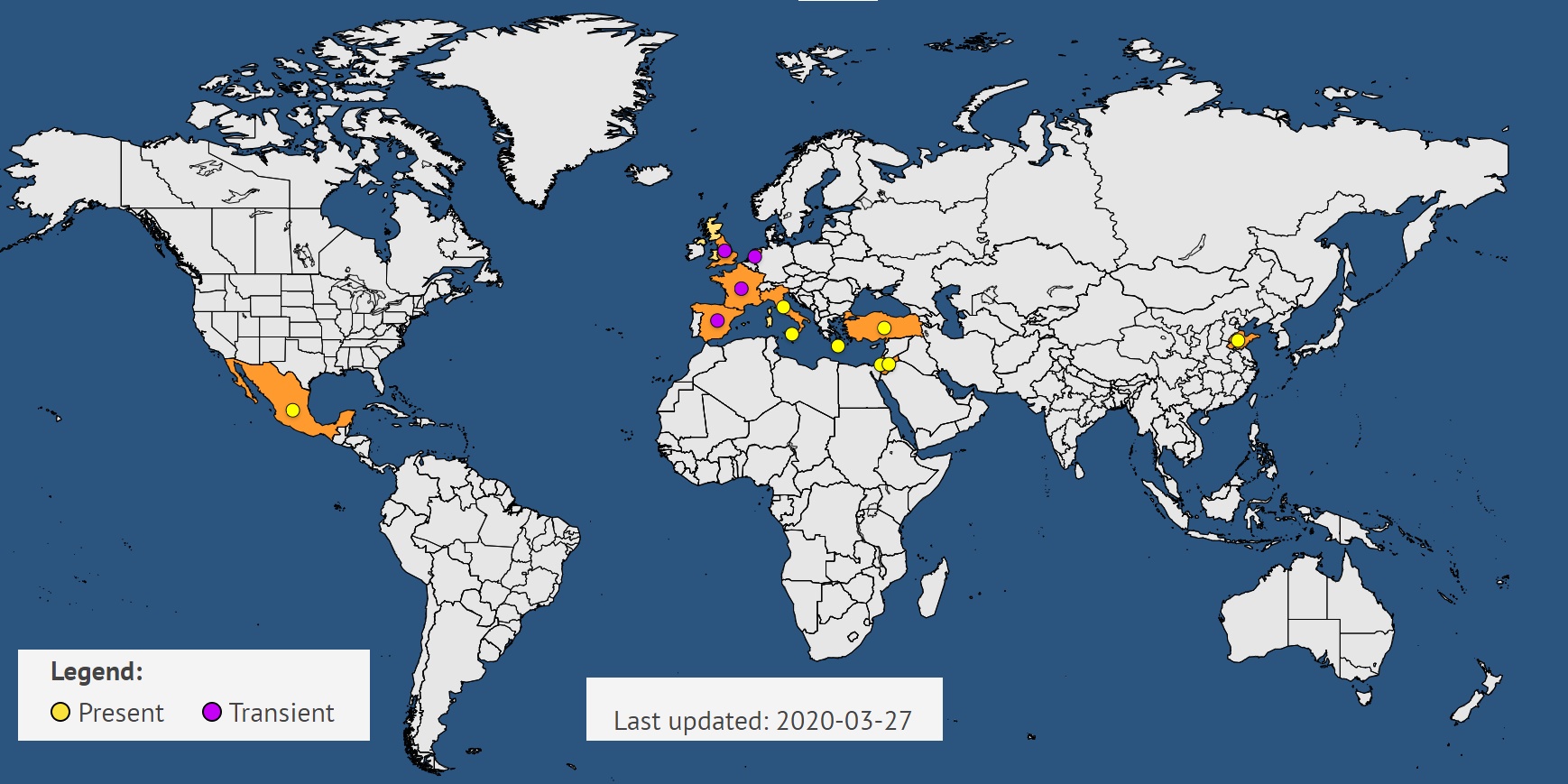
https://gd.eppo.int/reporting/article-6727
https://gd.eppo.int/taxon/TOBRFV/distribution
Sources: hortidaily.com, bfmtv, freshplaza.fr