News
Balancing Viral Resistance and Fertility in Tomatoes
Tomato yellow leaf curl virus (TYLCV) remains one of the most formidable obstacles to global tomato production, causing severe crop losses, stunted growth, and flower abortion. While breeders have long relied on wild tomato relatives to introduce resistance loci—most notably the ty-5 locus—these conventional sources often fail to provide complete immunity and can introduce yield penalties or fruit quality trade-offs.
A study recently published in New Phytologist sheds critical light on the genetic mechanism underlying ty-5 and points toward an innovative strategy for developing durable viral resistance without sacrificing crop fertility.
The ty-5 resistance locus stems from a single amino acid substitution in the PELOTA (PELO) gene, a critical factor involved in ribosome recycling and protein translation. Researchers investigated what happens when this gene is completely inactivated. Using CRISPR-Cas9 genome editing to create pelo loss-of-function mutants, scientists discovered that eliminating PELO function confers near-immunity to TYLCV. Mutant plants displayed virtually no disease symptoms and maintained nearly undetectable levels of viral DNA following whitefly inoculation.
However, this extraordinary viral resistance comes at a steep biological cost. While wild-type plants set fruit normally, complete loss of PELO function results in severe floral defects. Mutants exhibit disrupted, partially fused anthers, abnormal and non-viable pollen grains, and altered pistil structures, rendering the plants entirely sterile or capable of producing only seedless, parthenocarpic fruits.
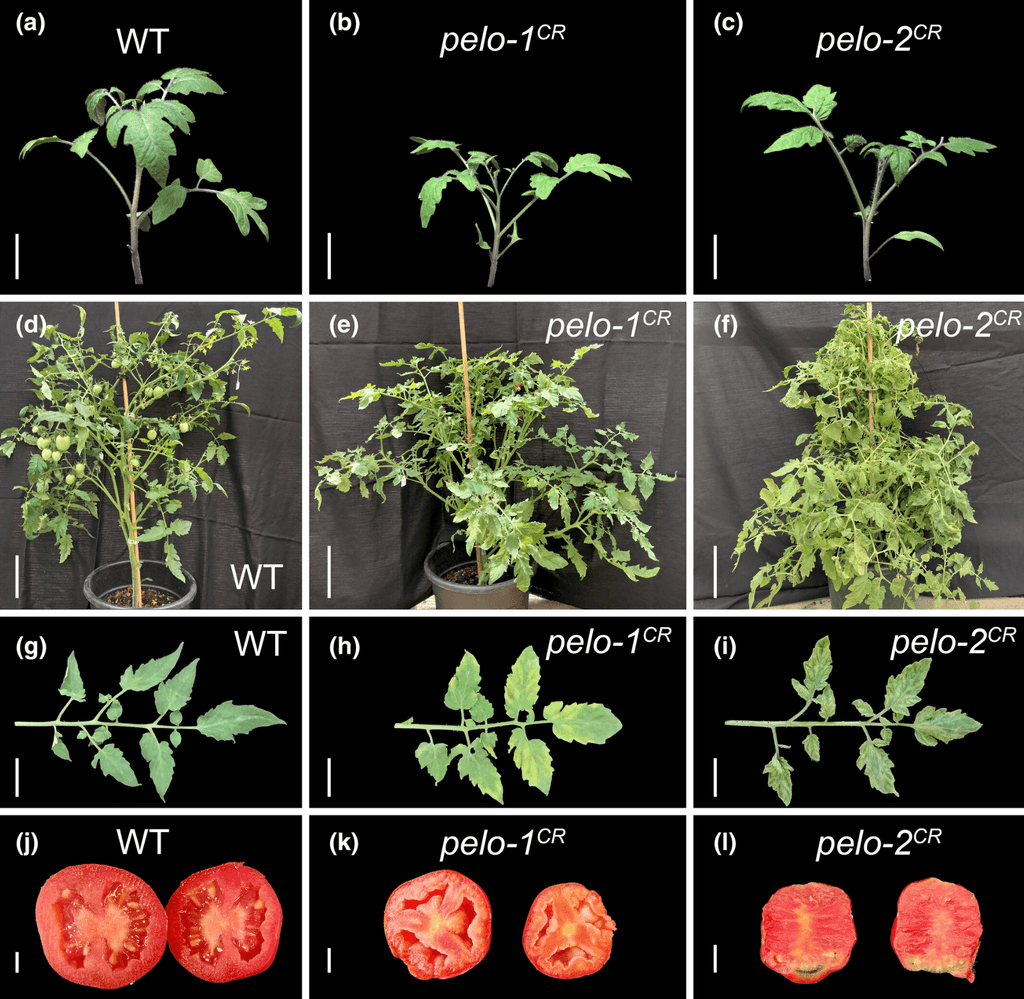
Expression analyses using reporter lines confirmed that PELO is active not only in young, virus-susceptible leaves but also heavily expressed in reproductive organs, explaining its essential dual role in supporting both viral propagation and plant fertility.
Because complete gene knockout triggers plant sterility, researchers sought a middle ground that could preserve fertility while maintaining strong viral resistance. Recognizing that ty-5 is a partial loss-of-function allele, the team hypothesized that PELO function is dosage-dependent.
To test this, scientists employed CRISPR-Cas9 promoter bashing to generate a series of modified PELO promoter variants with altered gene expression levels. Remarkably, specific promoter edits significantly reduced PELO transcript levels without causing any developmental or reproductive abnormalities. When inoculated with TYLCV, these promoter-edited lines exhibited significantly reduced symptom severity and viral accumulation compared to wild-type controls, performing comparably to traditional ty-5 resistant cultivars while maintaining normal fruit set and yield.
These findings demonstrate that absolute knockout of PELO is not required to achieve strong protection against TYLCV. By utilizing precision gene editing to fine-tune promoter activity rather than eliminating the gene entirely, breeders can successfully bypass the traditional trade-off between viral resistance and plant fertility. This promoter-bashing approach opens a promising avenue for developing robust, high-yielding commercial tomato varieties equipped with durable resistance to devastating begomoviruses.
Source: The New Phytologist
Singh, Z., Sufrin Ringwald, T., Dahan, Y., Gelbart, D., Kunta, S., Avni, B., Wasserstrom, H., Citovsky, V., Lapidot, M. and Burko, Y. (2026), PELOTA at the crossroads of tomato fertility and viral resistance. New Phytol.
https://doi.org/10.1111/nph.71715