News
Processed Tomato Products in Germany: Trade Data Analysis and Import Dynamics
Between 2021 and 2025, the German market for processed tomato products confirmed its massive structural dependence on foreign supplies. Restricted to secondary processing, Germany ranks among the world’s leading buyers of pastes, canned tomatoes, and sauces, bearing the full brunt of inflation and Mediterranean climate shocks. This analysis details the worsening national trade deficit, the geography of import-export flows, and the specific dynamics of each product category.
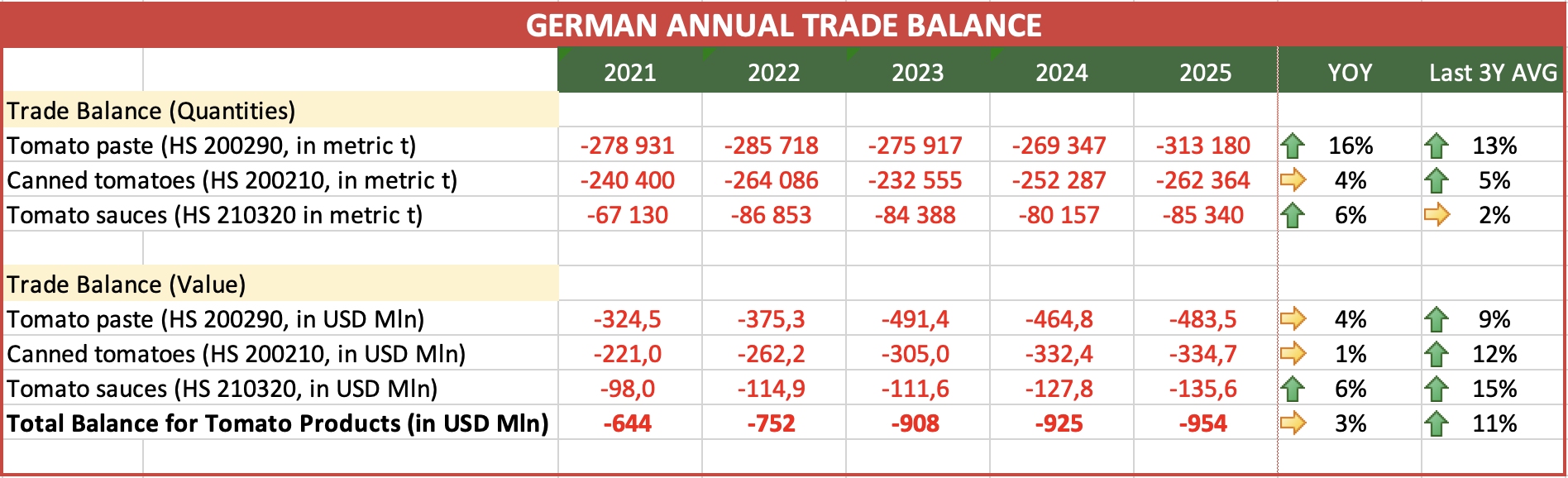
As shown by the German trade data available on our website www.tomatonews.com, between 2021 and 2025, the German trade balance for processed tomato products highlights a massive and structural financial deficit. Lacking the necessary conditions for industrial processing from open-field crops, Germany remains fully dependent on external supplies (mainly from the Mediterranean basin) to supply both its retail sector and its food industry.
Over the period as a whole, the overall trade deficit worsened sharply, widening from -USD 644 million in 2021 to a record -USD 954 million in 2025, representing a degradation of nearly 48%. While net imported volumes grew more moderately (+12.7%, reaching 660,884 metric tonnes in 2025), this sharp increase in value was mainly driven by the impact of inflation and surging production costs recorded in recent years.
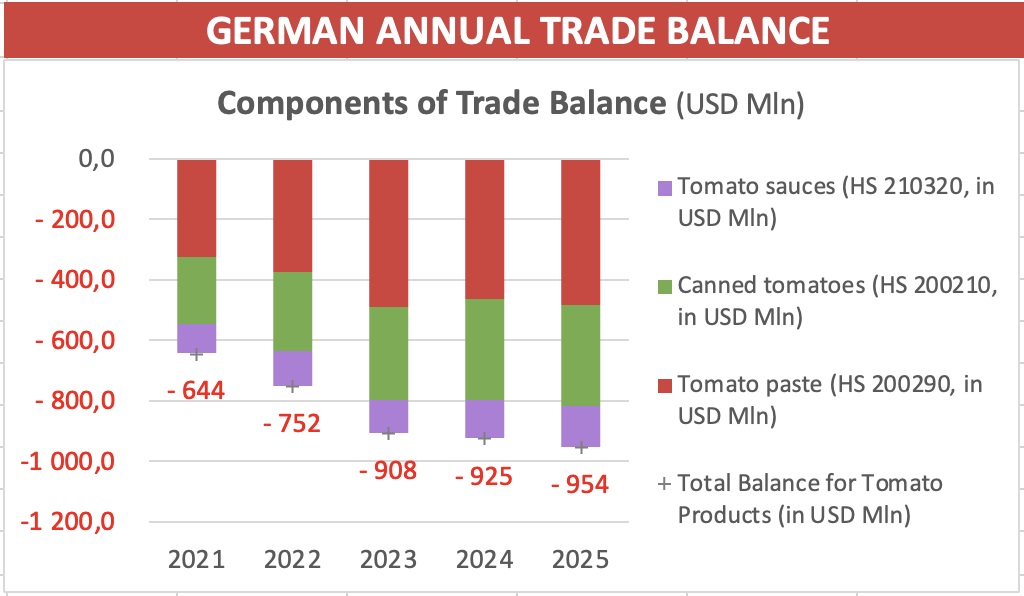
The year 2023 was the main turning point of the period. While overall imported volumes remained virtually stable (+1.1% compared to 2021), the value of the deficit surged by more than 41% to reach -USD 908 million. This discrepancy reflects the direct pass-through of climate pressures in Southern Europe (droughts) and rising costs for energy, transport, and packaging onto selling prices. The implicit average price of the German import basket thus rose from nearly USD 1,100 per metric tonne in 2021 to over USD 1,530 in 2023, before easing slightly to USD 1,443 in 2025.
Dynamics by Product Category
Tomato paste (HS 200290) is the primary import item in volume and value. Mainly intended for industrial processing (ready meals, soups, ketchup), tomato paste saw its deficit widen from -278,931 metric tonnes (-USD 324.5 million) in 2021 to -313,180 metric tonnes (-USD 483.5 million) in 2025. This category was hit hard by the price effect, with the value per imported metric tonne surging by over 50% between 2021 and the peak in 2023.
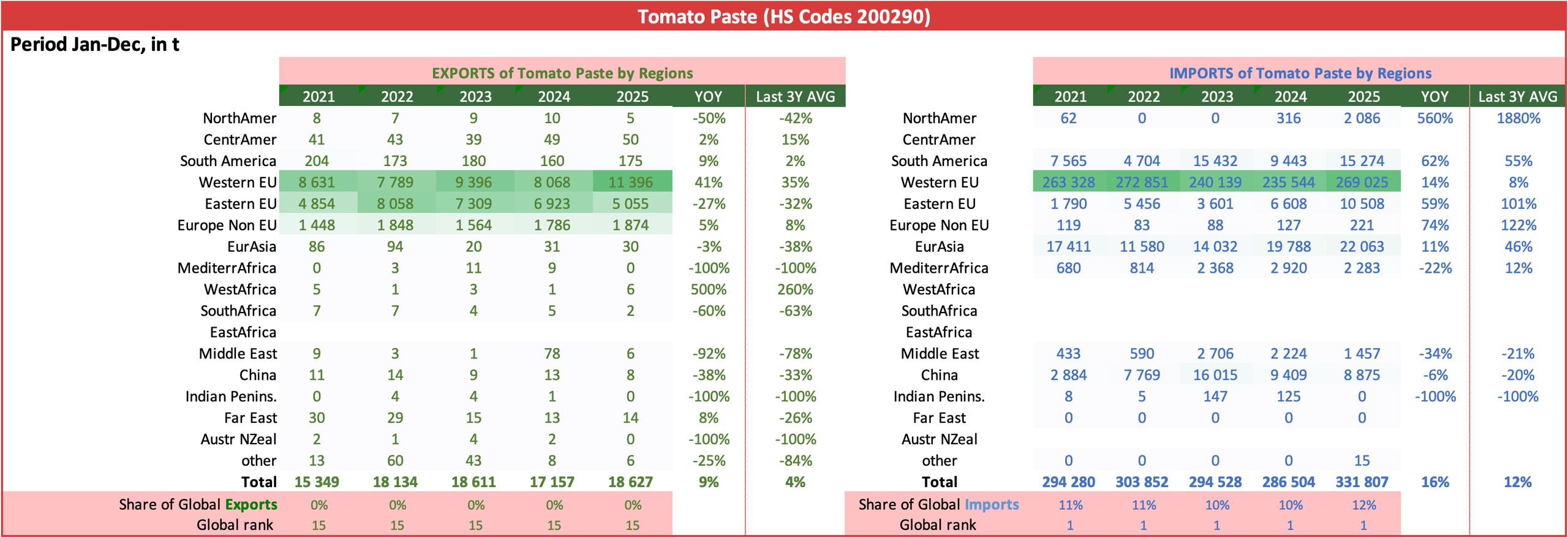
Between 2021 and 2025, Germany confirmed its status as the world’s leading buyer of tomato paste, accounting for 10% to 12% of global imports. Conversely, its exports remain marginal (15th worldwide, 0.5% market share) and limited to local cross-border trade.
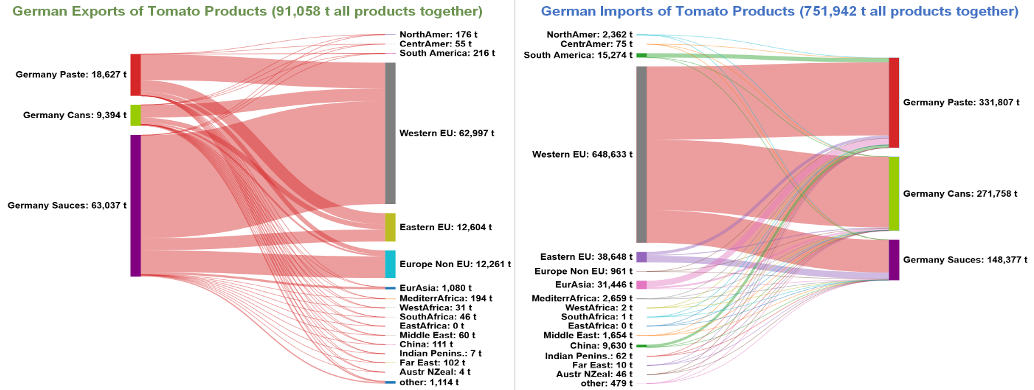
After a slight dip between 2022 and 2024, German demand rebounded strongly in 2025 to reach a peak of 331,807 metric tonnes (+16% year-on-year). Supply relies overwhelmingly on the European Union: Western Europe (Italy, Spain, Portugal) forms the core pillar of purchases at 269,025 metric tonnes in 2025, or 81% of total imports (+14% year-on-year). Eurasia (notably Turkey) has established itself as the second strategic partner with 22,063 metric tonnes (+46% vs the 3-year average). China stabilized at 8,875 metric tonnes after a surge in 2023, while South America (15,274 metric tonnes, notably Chile) and Eastern Europe (10,508 metric tonnes, Hungary, Poland) continued their progression.
German exports, although up to 18,627 metric tonnes in 2025 (+9% year-on-year), essentially reflect regional redistribution: Western Europe absorbs 61% of these volumes (11,396 metric tonnes, +41% year-on-year) and Eastern Europe 27% (5,055 metric tonnes), with the rest of the world remaining marginal.
Canned tomatoes (HS 200210) account for roughly 40% of total imports; imports of peeled, crushed, or whole tomatoes grew from -240,400 metric tonnes to -262,364 metric tonnes over the period. The deficit in value expanded steadily (+51.4%), rising from -USD 221 million to -USD 334.7 million due to consistently higher unit prices.
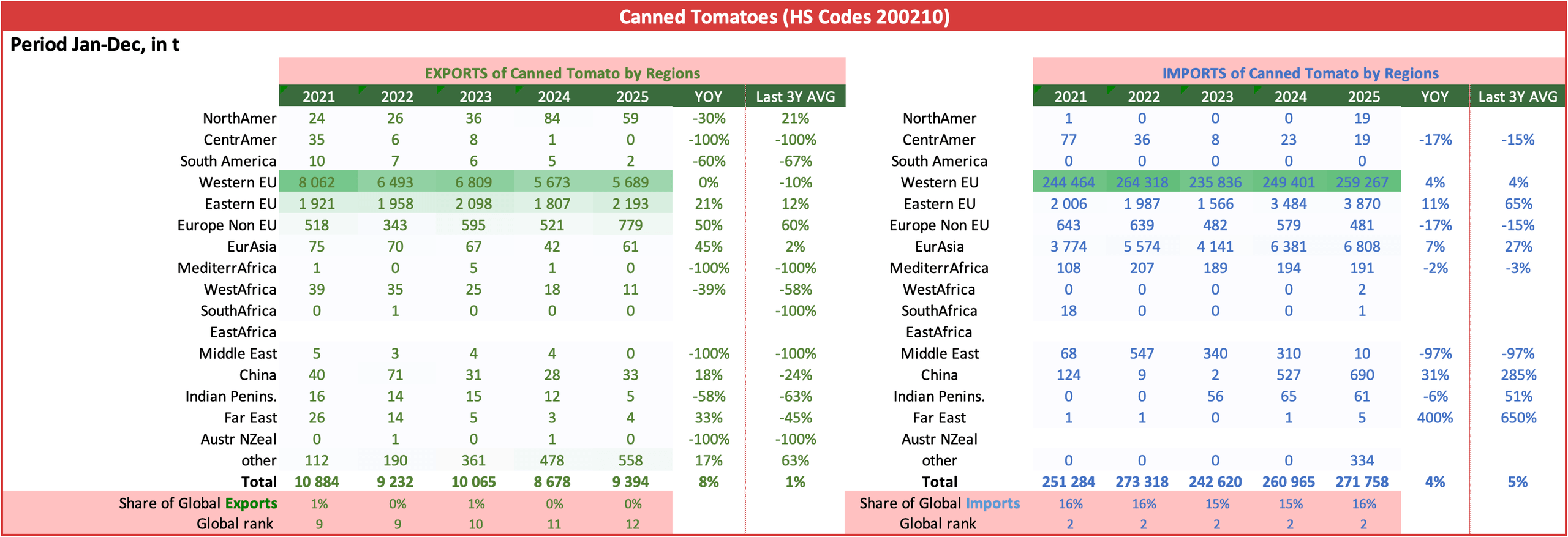
In the global canned tomato market, Germany holds a major strategic position as the world’s second-largest importer, capturing 15% to 16% of global volumes. Conversely, its role as an exporter remains secondary, ranking between 9th and 12th worldwide with a market share between 0% and 1%.
Over the 2021–2025 period, German imports displayed an overall upward trend despite a temporary dip in 2023. After a low point of 242,620 metric tonnes, purchases gradually recovered to reach 271,758 metric tonnes in 2025 (+4% year-on-year). The structure of this supply is characterized by an almost exclusive reliance on Western Europe (primarily Italy and Spain), which provided 259,267 metric tonnes in 2025, or 95.4% of total imports. Secondary sources include Eurasia (6,808 metric tonnes, notably Turkey) and Eastern Europe (3,870 metric tonnes, Poland), which recorded relative increases but remain marginal in volume.
German exports of canned tomatoes remain very modest and tend to stabilize around 9,394 metric tonnes in 2025 (+8% year-on-year). These flows correspond to local regional redistribution: Western Europe is the main outlet with 5,689 metric tonnes (60.6% of total exports), followed by Eastern Europe, which grew to 2,193 metric tonnes (23.3%). Sales outside the European continent remain anecdotal.
Although secondary in volume (12.9% of the total in 2025 at -85,340 metric tonnes), Prepared tomato sauces (HS 210320) recorded the strongest volume growth (+27.1% over four years). The financial deficit has now reached -USD 135.6 million, reflecting sustained demand from German consumers for ready-to-use products.
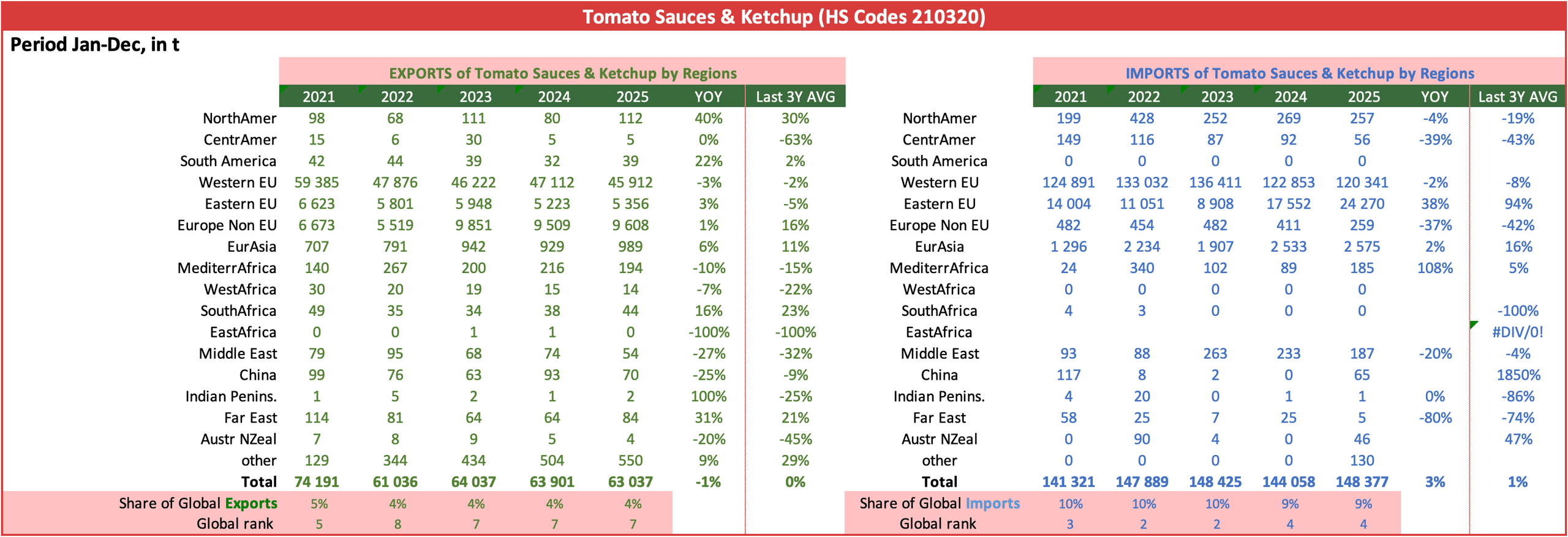
In the market for tomato sauces and ketchup, Germany plays a major and balanced role, ranking as the world’s 4th largest importer (9% of the global market) and 7th largest exporter (4% market share). Unlike the paste or canned tomato sectors, this high-value-added segment relies on dynamic processing and re-exporting activity.
Between 2021 and 2025, German imports remained very stable, moving from 141,321 metric tonnes to 148,377 metric tonnes in 2025 (+3% year-on-year). Supply structure relies mainly on Western Europe (Netherlands, Italy, and to a lesser extent Spain or Austria), which provided 120,341 metric tonnes (81.1% of total imports), followed by a rapidly growing Eastern Europe (Poland, Czech Republic) reaching 24,270 metric tonnes in 2025 (+38% year-on-year and +94% vs its 3-year average).
On the sales side, following a downturn in 2022, German exports stabilised around 63,037 metric tonnes in 2025 (-1% year-on-year). Germany distributes its processed products primarily to its European neighbours: Western Europe (France, Netherlands, Austria, etc.) absorbs 45,912 metric tonnes (72.8% of exports), Non-EU Europe 9,608 metric tonnes (15.2%, including Switzerland), and Eastern Europe 5,356 metric tonnes (8.5%). Shipments to other major consuming regions remain marginal.
Outlook and Summary
Germany stands at the heart of the European processed tomato market as a massive consumption hub and a major logistical crossroads. Restricted to secondary processing activities, the country relies almost exclusively on Southern Europe for its tomato pastes and canned tomatoes, while maintaining a dynamic industrial activity for the production and redistribution of sauces and ketchups. Following the slowdown caused by inflation in 2023 and 2024, physical demand rebounded sharply in 2025 (+9.8% in volume). Combined with unit prices remaining at elevated levels, this recovery in consumption pushed the German trade deficit to an all-time high, illustrating the country’s vulnerability to climatic and economic disruptions in producing nations.
Source: TDM