News
Research: Advances in green peeling technologies
A new review highlights recent advances in green and integrated tomato peeling technologies, emphasizing physical, biobased, and hybrid approaches that reduce energy and water use while enhancing nutrient retention and peel recovery.
The removal of the skin is an essential phase in the processing of most tomato-based products, including paste and puree. Generally, the skin, although rich in beneficial nutrients like dietary fiber, phenolic compounds, and antioxidants, is often regarded as waste or repurposed for low-value uses, such as livestock feed, thereby leading to inefficiencies within the food processing industry. Tomato peel waste, which is around 5–10 % of the raw tomato material in terms of weight, totals millions of tonnes every year. Such underuse of peel residues not only increases the loss of potential value-added production but also causes environmental and economic costs.
The most widespread techniques employed in the peeling of tomatoes on an industrial scale are thermal and chemical, and they entail steam scalding and treatment using sodium hydroxide. These traditional techniques are being widely utilized because of their effectiveness and ease; nonetheless, they possess some very serious drawbacks. Although thermal peeling is effective, but energy-intensive, raising costs and environmental impacts while degrading heat-sensitive nutrients like lycopene, flavonoids, and other polyphenols. Meanwhile, chemical peeling with sodium hydroxide generates alkaline wastewater requiring costly treatment and can reduce product quality by diminishing nutrients and altering flavor and texture.
These limitations highlight the need for greener tomato peeling technologies that balance efficiency, environmental sustainability, and nutrient retention, in line with regulatory pressures for circular economy and carbon neutrality. Recent advances in non-thermal, enzymatic, and physical-field-assisted methods (e.g., PEF, infrared, ultrasound, biobased chemicals) and mechanical approaches such as abrasive or laser peeling show promise for reducing energy use, limiting chemicals, preserving bioactives, and improving sustainability by enhancing functional compound recovery and enabling enzymatic hydrolysis of the middle lamella. However, despite minimizing thermal and chemical treatments, these technologies face challenges related to scalability, cost, and product quality.
As new alternative peeling technologies have evolved, there has also been increased interest in the uses of tomato peel wastes. The bioactive substances in the peel, such as pectin, lycopene, and phenolic compounds, have attracted significant attention due to their possible applications in the food, pharmaceutical, and cosmetic sectors. Through such value addition of tomato peel waste, it is feasible to minimize waste generation and concurrently create economic value, thereby tackling environmental issues hand in hand with the necessity for resource efficiency.
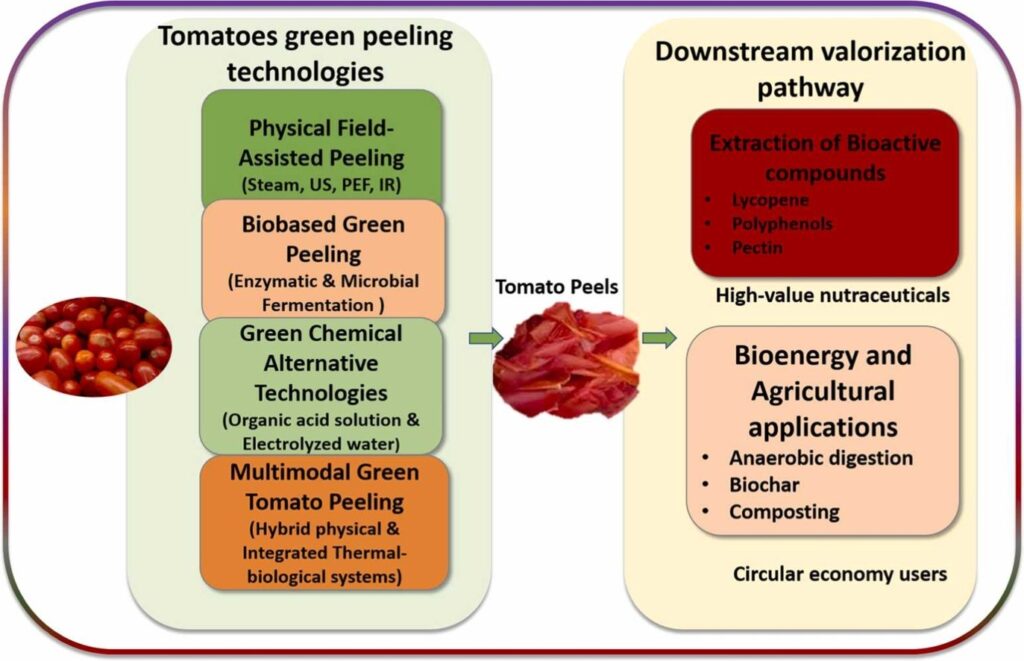
Therefore, this review aims to provide a holistic identification and assessment of green peeling technologies that trade off processing efficiency against nutritional and environmental factors, and explore the feasible pathways for the valorization of the resulting peel waste into valuable bioactive compounds. It provides an updated and interdisciplinary synthesis throughout the domains of food engineering, bioprocessing, green chemistry, and circular economy. Based on a critical examination of each technology in terms of kinetic performance, peel selectivity, environmental footprint, and retention of bioactives, the review delineates application-specific advantages and drawbacks. Further, the market potential for valorized peel constituents in food, pharma, and cosmetic uses is examined. The overall aim is to inform sustainable tomato processing innovations that are compatible with resource conservation, food quality, and waste valorization objectives.
Reference: Abdullateef Taiye Mustapha, Chen Li, Zhou Cunshan, Hafida Wahia, Advances in green peeling and circular valorization of tomato peel waste in food processing, Food and Humanity, Volume 5, 2025, 100862, ISSN 2949-8244,
Full text: https://doi.org/10.1016/j.foohum.2025.100862 (subscription required)